

AHE-600-D03 Installation Manual
Aqua-Hot Hydronic Heating System


Installation
Installing the Mounting Tray and the Aqua-Hot:
The Aqua-Hot must be installed in a compartment that is completely closed-off from living quarters and accessible only from the outdoors.
- Reference the following illustrations for mounting information:
- Overall Aqua-Hot dimensions - Figure 7
- Mounting tray information - Figure 8
- I.D. Label noting the “Open Access” clearance requirement for the front of the heater - Figure 5
- Service access clearances - Figure 6
|
Note: Be sure to complete the following when installing the Aqua-Hot:
|
- Cut out the required mounting tray opening. Reference Figure 8.
- Install the mounting tray flange into the cut-out opening. Reference Figure 8.
- Insert a #10 machine screw into each of the embossed holes in the mounting tray (total of six required) and tighten to secure the mounting tray to the motorhome.
|
Note: Secure the mounting tray into place prior to installing the Aqua-Hot. Remove the access cover fastener from the AquaHot prior to installation of the Aqua-Hot into the mounting tray. Mount the Aqua-Hot securely into the mounting tray to ensure that the unit does not move or shift under normal operating conditions. |
- Place the Aqua-Hot into the mounting tray. Reference Figure 9.
| Note: Remove the bolt securing the front of the access cover to the mounting tray; this bolt will need to be reinstalled once the total installation procedure is complete. Remove the access cover. |


Installing the Expansion Tank:
Select a mounting location that allows for easy access and clear visibility whenever the particular storage bay door is open.
| Note: The top of the expansion tank should always be mounted at least 4 inches higher than the highest point on the Aqua-Hot. Reference Figure 10. |
- Mount the expansion tank as illustrated in Figure 10.
- Connect and clamp the overflow tubing from the expansion tank to the Aqua-Hot’s expansion tank connection. Reference Figure 10.
- Drill a hole in the bay floor and connect (secure with a clamp) a long enough piece of overflow tubing so that it can be connected to the top of the expansion tank and extend through the bay floor.

Hydronic Heating System
Heat Exchanger Locations and Clearances:
- Place the heat exchangers so that even heat distribution will be felt throughout the interior of the motor home. Reference Figure 15A.
| Note: For single slide-out configurations, it is usually simplest to place a heat exchanger on the opposite side of the motor home pointing towards the slide-out. |
- Place the heat exchangers where they will be accessible for potential servicing and cleaning.
- Centralize and position a heat exchanger in the fresh water storage tank plumbing bay. Reference Figure 13.
| Note: In order to achieve the best heating results, place the heat exchanger as close to the floor of the plumbing bay as possible (heat will naturally rise). |
- Reference Figures 14, 15A, 15B, and 16, for mounting location information.
- Reference Figure 14 for clearance information.
| Note: An accessory device is available for the Cozy Heat Exchanger for the purpose of redirecting the airflow from the heat exchanger. Reference Figures 17 and 18. |
Mounting Requirements:
- Sufficient ventilation (return-air) must be supplied to each interior heat exchanger. Reference Figure 16.
| Note: Ventilation (return air) must be supplied from the living area. Ventilation (return air) MAY NOT be supplied from the bay area. |
| Note: Mounting the heat exchangers without sufficient ventilation will severely reduce their overall heating performance (heat output). In order to provide sufficient ventilation, the return-air registers must be the same size, or larger, than the outlet-air registers. Return-air must be supplied from the corresponding interior heating zones. |


Mounting the Heat Exchangers:
- Cut out a 2.5 inch H x 10 inch W opening for each heat exchanger outlet and cold-air return register. Reference Figure 21.
- Mount each heat exchanger permanently into place. Reference Figures 20 and 21.
- Install the hot-air outlet and cold-air return registers. Reference Figure 16.
| Note: Please note that a return-air register may not be required; however, adequate return-air must be provided to each particular heat exchanger. This means that the total cross-sectional area of the return-air opening must be equal to or greater than the crosssectional area of the hot-air outlet opening of the heat exchanger. |

If the toe-kick areas in the motorhome are inadequate to house a heat exchanger for regular installation, a plenum may be used on the heat exchanger, which can be used with a smaller vent as seen in Figure 18. The plenum allows only the desired outlets to be opened by removing the metal insert on the vent.


Wiring the Heat Exchangers:
- Run two 18-gauge wires, red for (+) and black for (-), from each particular heating zone’s heat exchanger to the electronic controller. Reference Figure 23.
- Label the wires indicating the heating zone they pertain to (e.g., Living Room, Bathroom, Bedroom, etc.).
- Insert all heat exchanger wires into the appropriate terminal/heating zone location on the electronic controller. Reference Figure 22 and Appendix A.
- Wire all heat exchangers in a zone in-series. Reference Figure 23 and Appendix A.
- Connect all electronic controller wires to the positive and negative leads of the heat exchanger. Reference Figures 23 and 24.


When wiring the heat exchangers in-parallel, the main 18- gauge wire is split to allow the heat exchanger wires to combine with the main wire to be powered or grounded, respectively.

Plumbing Requirements:
- Once all heat exchangers have been mounted, formulate a plan for the routing of the plumbing lines from each heating zone to the Aqua-Hot.
- All plumbing lines should be laid as flat as possible, and any extreme rises in height should be avoided to eliminate any potential air-traps.
- The kitchen and living room heat exchangers (up to 4) must be plumbed together in-series on “Heating Loop 3.” Reference Figure 26
- The fresh water tank, and bathroom heat exchangers (up to 4) must be plumbed together in-series on “Heating Loop 2.” Reference Figure 26.
- The bedroom heat exchanger must be plumbed on “Heating Loop 1.” Reference Figure 26.
- Use ⅝ inch I.D. (Inside Diameter) plumbing lines for all heating loops.
- Use wide-sweeping elbows or “bend supports” whenever the plumbing lines may be susceptible to kinking (i.e., 90° bends).

Plumbing the Hydronic Heating System:
- Lay out the plumbing lines for all heat exchangers.
- Label each line with the heating loop number and designate as an inlet or an outlet line.
|
Note: Run all plumbing lines in areas where they cannot be pinched off or damaged under normal operating conditions. Be sure to secure all lines where necessary and apply protective shielding in areas where chafing may occur. Rubber Coated/Closed-Type clamps are recommended when securing the plumbing lines. |
- Connect and clamp the outlet line from the heater to the lowest port on the heat exchanger with the longest run, for both heating loops. Reference Figure 27. Then, connect each additional heat exchanger in the same arrangement (low to high).
- Connect and clamp the inlet line from the heater to the highest port on the last heat exchanger for both heating loops. Reference Figure 27.
|
Note: Reference Figure 28 for visual instructions on connecting PEX-type tubing to each heat exchanger. Plumbing heat exchangers in this manner will allow air to escape naturally. If air is trapped in any heat exchanger, it will significantly reduce the heat exchanger’s overall heating performance (heat output). |
- Connect and tighten all interior plumbing lines, outlet and inlet, to the Aqua-Hot’s appropriate heating loop ports. Reference Figure 29 and Figure 30.
| Note: The inlet and outlet plumbing lines can be installed with a straight fitting or an elbow fitting. |


Fresh Water Tank Thermostat Locations:
Select a location that will ensure even-heat distribution throughout the fresh water storage tank bay compartment in order to prevent the domestic water and plumbing system from freezing.
Typically only the bulb of the thermostat needs to be physically mounted in the area requiring heat (usually in close proximity to the domestic water pump). Reference Figure 31.
Do not mount the thermostat bulb in a drafty area or along the ceiling of the bay.
The selected mounting location should allow for easy operator access and should be as low in the bay area as possible.
Avoid mounting the fresh water tank thermostat’s bulb too close to the bay heat exchanger.
Fresh Water Tank Thermostat Mounting:
- Select a location for the thermostat bulb in the fresh water storage tank bay compartment.
- Once the thermostat has been completely wired, permanently mount the thermostat in place. Reference Figure 31.
Fresh Water Tank Thermostat Wiring:
- Run two 18-gauge wires from the thermostat’s mounting location to the Aqua-Hot’s electronic controller.
| Note: It is recommended that the wire numbers in Appendix A be used when installing the Aqua-Hot in order to assist with differentiating between the separate heating zones and to aid service personnel with troubleshooting. |
- Insert each thermostat wire into the appropriate terminal/heating zone location in the electronic controller. Reference Appendix A and Figure 32.
- Connect both wires to the appropriate leads of the thermostat. Reference Figure 31.

Thermostats
Room Thermostat Locations:
Select a location that will insure even-heat throughout each heating zone. Locate each thermostat at approximately chest level, if applicable.
|
Note: The selected location should prevent the thermostat from being affected by:
|
Room Thermostat Mounting:
Once the room thermostat has been wired, permanently mount the thermostat in place. Be sure to then turn OFF all interior room thermostats.
Room Thermostat Wiring:
- Run two 18 gauge wires from each room thermostat mounting location to the Aqua-Hot’s electronic controller. Reference Appendix A.
| Note: It is recommended that the wire numbers in Appendix A be used when installing the Aqua-Hot in order to assist with differentiating between the separate heating zones and to aid service personnel with troubleshooting. |
- Insert all room thermostat wires into the corresponding zone number location on the electronic controller. Reference Appendix A and Figure 32.
- Connect all wires to the appropriate leads of each room thermostat.

Domestic Water System
Domestic Water System Requirements:
| Note: Please note that it may be necessary to utilize an accumulator tank within the domestic water system. Reference Figure 34. Although the Aqua-Hot is equipped with a pressure-relief valve, the use of an accumulator tank will help prevent excessive “weeping” of the valve. Manufacturers of pressure-relief valves indicate that excessive weeping of these valves will cause the “seat” in the valve to deteriorate, and, in turn, the valve will fail prematurely. For additional information regarding accumulator tanks, please be sure to reference the Recreational Vehicle Industry Association’s (RVIA) technical publication titled “Recreational Vehicle Plumbing Systems.” To obtain a copy of this particular publication, please contact RVIA at (703) 620-6003 or visit them online at www.rvia.org. |
Use the RVIA-provided table below in order to determine the proper sizing of pipe and tubing required to insure maximum efficiency. The size of water supply piping and branch line shall not be less than specified in the table below.
| Note: A water heater or ice maker shall not be counted as a “water-using fixture” when computing pipe sizes. |
|
Note: As stated directly from the ANSI A119.2/NFPA 501C Standard on Recreation Vehicles, 1993 Edition: “Piping Systems shall be sized to provide an adequate quantity of water to each Plumbing Fixture at a flow rate sufficient to keep the Fixture in a clean and sanitary condition without any danger of back-flow or siphoning.” The Aqua-Hot is equipped with a pressure-relief valve, which releases excessive pressure in the domestic water system, if necessary, as well as a tempering valve in order to regulate the temperature of the hot water. |
Domestic Water System Plumbing:
- Connect a domestic water plumbing line from the domestic water demand pump/water manifold to the cold water inlet port on the Aqua-Hot. Reference Figures 33 and 34.
- Connect a domestic water plumbing line from the AquaHot’s hot water outlet port to the hot water system’s distribution lines/water manifold. Reference Figures 33 and 34.
|
Number of Fixtures
|
Inner Dia. (Inches) (Tubing) |
Outer Dia. (Inches) |
Iron Pipe Size (Inches) |
| 1 | 1/4 | 3/8 | 3/8 |
| 2 | 1/4 | 3/8 | 3/8 |
| 3 | 3/8 | 1/2 | 1/2 |
| 4 | 3/8 | 1/2 | 1/2 |
| 5 or more | 1/2 | 5/8 | 1/2 |


Switch Panel Location:
Select a location in the interior of the coach that allows for easy operator access.
All electric installations, systems, and equipment shall comply with Article 551, Parts I and III through VI of NFPA 70, as well as the regulation of authorities having jurisdiction and CSA Standard B139.
Switch Panel Mounting:
- Cut out a 5” W x 1.25” H opening for the switch panel plate. Reference Figure 35.
- Once the switch panel has been completely wired, permanently mount the switch panel in place.
- Move both switches to an OFF position by pressing them in a downward motion.
Switch Panel Wiring:
- Run 16-gauge wires from the switch panel to the electronic controller.
| Note: It is recommended that the wire colors illustrated in Appendix A be used when installing the switch panels. This will ensure installation consistency, differentiate between the separate switches and assist service personnel with troubleshooting. Reference Appendix B for proper wire-gauge sizing. |
- Strip and crimp insulated female terminals onto each wire at the switch panel location.
| Note: Be sure to attach “Jumper Wires” where necessary. Reference Figure 36. |
- Connect all switch wires to the appropriate switch connections as illustrated in Figure 36. Reference Appendix A for additional wiring information.
- Insert all switch wires into the appropriate terminal/switch panel connection on the electronic controller. Reference Appendix A.


Fuel System
Fuel Filter Location:
Mount the fuel filter assembly in a location that provides easy access for replacing the filter element and for catching any potential fuel spillage when servicing.
Fuel System Requirements:
- The diesel fuel supply should be drawn directly from the vehicle’s main fuel tank or from a separate auxiliary fuel tank, if applicable.
- The fuel tank should be equipped with a dedicated fuel pick-up pipe (outlet port and inlet port). Reference Figure 38.
|
Note: If an auxiliary fuel tank is required, be sure to consult the ANSI/NFPA 1192 handbook concerning heating systems’ diesel fuel system specifications. Also, be sure to reference the ANSI/NFPA 1192 handbook for information regarding fuel distribution system specifications. |
- Use 1/4 inch I.D. (Internal Diameter) fuel lines.
- The combined length of the supply and return fuel lines should not exceed 100 feet in total length. Reference Figures 39.
- All fuel-fitting hardware (i.e., at the vehicle’s fuel tank, fuel filter, and Aqua-Hot fuel parts) must be 1/4 inch NPT or greater with a 1/4 inch barbed fitting. Fuel fittings less than 1/4 inch NPT may restrict fuel flow, thereby compromising the diesel-burner’s performance.
Fuel System Installation:
- Run two 1/4 inch fuel lines from the fuel tank inlet and outlet ports to the Aqua-Hot. Both fuel lines should be laid as flat as possible and any extreme rises in height should be avoided in order to eliminate any potential air-traps. Run both fuel lines in areas where they cannot be pinched, kinked, or damaged during normal operating conditions. Run the fuel tank outlet fuel line past the fuel filter location in preparation for step 7.
- Be sure to secure all fuel lines where necessary and apply protective shielding in areas where chafing may occur.
- Label both fuel lines indicating whether they are an outgoing line or an incoming line.
- Connect the Aqua-Hot’s fuel lines to the vehicle’s fuel tank. Reference Figure 38.
- Install and tighten the appropriate fuel fittings onto the Aqua-Hot’s fuel ports, as well as the two ports of the fuel filter. Reference Figures 41.
- Connect the inlet and outlet fuel lines to the Aqua-Hot’s fuel port connections. Reference Figure 41.
- Cut the fuel line at the fuel filter mounting location and connect the fuel lines as illustrated in Figures 40.
| Note: Be sure that the flow of fuel through the filter is in the correction direction as illustrated in Figure 40. |


Engine Preheat & Motoraide System
The Aqua-Hot 600-D includes a motoraide feature, which uses the circulation of the motorhome’s engine to transport the antifreeze and water heating solution from the Aqua-Hot’s boiler tank to the motorhome’s warm engine and back to the boiler tank. The Aqua-Hot 600-D also includes an engine preheat feature. This preheat feature provides an easy engine start-up whenever cool weather conditions are present.
Location: The inlet and outlet ports on the vehicle’s engine should be kept as far apart as possible. This will ensure that the entire engine is thoroughly preheated. Reference Figure 42.
|
Note: If assistance is needed in determining the best inlet and outlet ports for a specific engine, please contact the particular engine’s manufacturer or chassis supplier. The engine’s coolant should be allowed to flow as freely as possible to maximize the Aqua-Hot’s engine preheating system. The engine’s inlet port is where the heated coolant is transported to the engine block from the Aqua-Hot. This port should be a high connection point on the engine block. Reference Figure 42. The engine’s outlet port is where the engine’s coolant is transported to the Aqua-Hot. This port should be a low connection point on the engine block or a pressure outlet port on the engine’s water pump. Reference Figure 42. Ensure that the engine preheat inlet and outlet hoses are not placed too close to the engine’s turbo charger. |
Plumbing Requirements:
Use ¾ inch I.D. (Inside Diameter) plumbing lines/automotive-type heater-hose for the engine preheating system.
Lay both engine preheat lines as flat as possible and avoid any extreme rises in height in order to eliminate the potential for air traps.
Run both plumbing lines in areas where they cannot be pinched off or damaged during normal operating conditions. Secure both plumbing lines where necessary and apply protective shielding in areas where chafing may occur.
| Note: Rubber coated/closed-type clamps are recommended when securing the plumbing lines. |
Use one-piece engine plumbing fittings in order to reduce the potential for coolant leaks. It is recommended that pipe thread sealant be used on all engine plumbing fittings.
Installing the Plumbing:
- Install both engine preheat plumbing lines and mark with arrows and/or labels at both ends.
| Note: The labels should indicate whether the plumbing line is transporting coolant to the Aqua-Hot or whether it will be transporting heated coolant to the vehicle’s engine. Reference Figure 42. |
- Drain the engine’s coolant.
- Remove the selected inlet and outlet port “plugs” from the engine.
| Note: Should one or both of the selected engine ports already have plumbing fittings attached to them, it may be necessary to “tee” into those existing plumbing fittings. Please contact the Aqua-Hot Heating Systems product application department at 1-800-685-4298 for additional assistance. |
- Install and tighten the plumbing fittings into the inlet and outlet ports on the vehicle’s engine.
- Install and clamp both the inlet and outlet engine plumbing lines/automotive-type heater hoses to the engine’s plumbing fittings. Reference Figure 43.
- Install and tighten a plumbing fitting into the “Inlet” port on the Aqua-Hot’s engine preheating system. Reference Figures 1 and 43.
- Attach and clamp the engine’s incoming plumbing line to the Aqua-Hot’s outlet connection. Reference Figure 43.
- Attach and clamp the engine’s outgoing plumbing line to the Aqua-Hot’s inlet connection. Reference Figure 43.
- Verify that all fittings and connections have been tightened, then refill the engine’s coolant system.

Exhaust System
| Warning |
|
| Note: Refer to “Internal Combustion Engine Exhausts and Vehicle Wall Openings” in RVIA’s ANSI/NFPA 1192 Handbook for the Recreational Vehicle Standards, as well as the National Fire Protection Association’s (NFPA) 1192 Standard on Recreational Vehicles for additional information. |
Exhaust System Requirements:
The exhaust must be able to freely exit away from the vehicle without any obstructions. Angle the exhaust pipe towards the rear of the vehicle so that the exhaust fumes will naturally move away while the vehicle is in motion. Reference Figure 45. Use a minimum 1-3/4” ID automotive-type exhaust piping and avoid bends, if possible. Reference Figures 44 and 47. A maximum of 270º exhaust pipe bends are allowed. Reference Figure 44.
Do not use galvanized pipe or fittings; only black-iron pipe and fittings should be used. Reference Figure 47.
The total length of exhaust pipe should not exceed 27.5 feet with 270⁰ of bends.
The Aqua-Hot is supplied with a 3 inch and a 4 inch black pipe nipple (1½ inch diameter) along with a 1½ inch exhaust elbow. Reference Figure 45. These three exhaust system components MUST BE utilized with all product installations. Be sure to reference Figure 46 and 47 to determine which exhaust nipple should be connected directly to the Aqua-Hot’s exhaust port (i.e., the 3 inch or the 4 inch black pipe nipple).
| Note: Should the particular application require more than 27.5 feet of exhaust pipe, please contact the Aqua-Hot Heating Systems Product Application Department at 1 -800-685-4298 for assistance. |
Installing the Exhaust System:
- Run the exhaust pipe to the driver’s side or the rear of the vehicle and ensure that the exhaust fumes cannot enter into the passenger compartment. Be sure to keep the exhaust away from the slide-out areas.
- Be sure to secure the end of the exhaust pipe to the vehicle with the proper exhaust hanger/support hardware.


Electronic Controller Wiring
Most electronic controller thermostat and switch connections possess an “(I)” or an “(O)” symbol. The “(O)” symbol indicates a positive 12 Volt-DC output to a particular thermostat or switch, while the “(I)” symbol indicates a positive 12 Volt-DC input signal from a particular thermostat or switch. The 12 Volt-DC output signal is always present as long as the electronic controller is powered by a 12 Volt-DC power source, while the 12 Volt-DC input signal is only present whenever a switch is activated or whenever a thermostat is calling for heat. Reference Appendix A.
All electronic controller fan power connections (and two switch connections) illustrate a “(+)” or a “(-)” symbol, which indicates that they are polarity-sensitive. Therefore, be sure to use care when wiring these particular components to the electronic controller.
Each heating zone “FAN” circuit can supply up to 2.0 Amps of direct current. This 12 Volt-DC power source allows for multiple Cozy III heat exchangers to be wired “in-parallel”. Reference Figure 44 and Appendix A.
| Note: A maximum power consumption of 24 Watts can be supplied by the electronic controller for each “FAN” heating zone. |
Heating Zone 1 is reserved electrically for the “Bedroom Heating Zone” (Heating Loop 1) ONLY.
Heating Zones 2, 3, and 4 are reserved electrically for the “Bathroom and Fresh Water Tank Heating Zone” (Heating Loop 2) ONLY.
Heating Zone 5 is reserved electrically for the “ Living Room and Kitchen Heating Zone” (Heating Loop 3) ONLY.
All switch connections are to be wired directly to the Aqua-Hot’s interior switch panel. Reference Figures 44 and 44 and Appendix A. Both the “IND-LT (+) B3” and the “IND-LT(-) B6” connections on the electronic controller are reserved electrically ONLY for the dieselburner switch indicator light connections.
The Aqua-Hot’s electronic controller is designed to work with most electronic room thermostats; however, the chosen thermostat must produce a constant 12 Volt-DC output signal and must receive its 12 Volt-DC power supply from the electronic controller.

| Caution: |
| DO NOT activate the diesel-burner until the antifreeze and water heating solution has been added to the boiler tank and the heating system has been completely bled of air. Operating the Aqua-Hot without the antifreeze and water heating solution will cause serious damage to the Aqua-Hot’s boiler tank. |
| Warning |
| DO NOT connect the 12 Volt-DC power to the Aqua-Hot if the vehicle requires welding. Electrical welding will cause serious damage to the diesel-burner controller and the Aqua-Hot’s electronic controller. |
|
Note: Reference Appendix B for proper wire-gauge sizing. Please note that under full-load conditions, the Aqua-Hot can draw as much as 20 Amps of DC current. Because the Aqua-Hot is designed to shut down in the event that the DC voltage level drops too low to properly operate, it is imperative that the proper wire gauge be determined and utilized. Be sure to protect against accidental shorting (i.e., chassis shorting) by incorporating a 20-Amp rated in-line fuse into the power wire at the battery location. Reference Figure 50. All electric installations, systems, and equipment shall comply with Article 551, Parts I and III through VI of NFPA 70, as well as the regulation of authorities having jurisdiction and CSA Standard B139. |
Wiring Harness Connection:
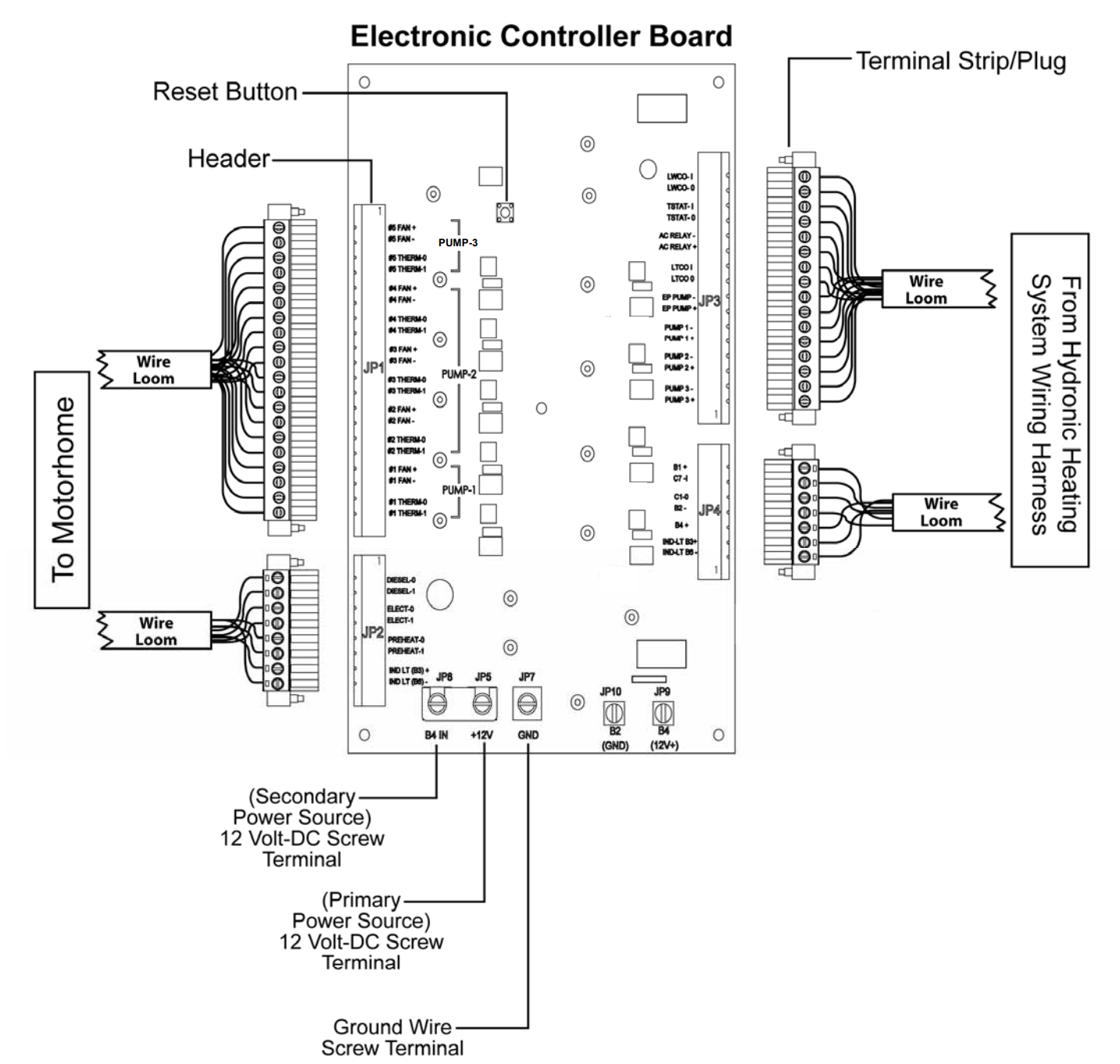
- Attach wiring harness connectors to the electronic controller. Reference Figures 48 and 49 and Appendix A.
- Tighten the screw-type fasteners on the terminal strips to secure them to the electronic controller. Reference Appendix C.

- Calculate the necessary wire gauge for the 12 Volt-DC power and ground wires.
- Determine the total maximum amperage draw of the Aqua-Hot heating system by adding the total maximum Amps of the installed heat exchangers (consult the heat exchanger manufacturer for Amp-draw information) to the Aqua-Hot heater’s 22 Amps.
- Determine the total length of wire required to connect the Electronic Controller to the vehicle’s battery.
- Reference Appendix B with the total Amps and length of wire to determine the necessary wire gauge. For example, an Aqua-Hot heater with 6 Aqua-Hot Cozy heat exchangers with the Electronic Controller placed 15 feet from the vehicle’s battery would require an 8-gauge wire.
- Run and connect two wires –– one red (+) wire and one black (-) wire (power and ground), from the vehicle’s main battery disconnect to the Aqua-Hot’s electronic controller. Reference Appendix A and Figure 51.
- Label the wires indicating whether they are a power or a ground wire.
- Attach the DC power wires onto the appropriate terminal/ battery connections on the electronic controller. Reference Appendix A.
- Connect both power and ground wires directly to the vehicle’s main battery disconnect.
Connecting the 120 Volt-AC Power:
- Run two 12-2 ROMEX wires, with grounds, from two over-current protected (20Amp circuit breaker required) 120 Volt-AC power supplies, through the Aqua-Hot’s cable clamp fitting and to the appropriate terminal block. Appendix A and Figure 50.
- Secure the wires into their terminals by tightening the corresponding screw on the terminal block. Tighten the terminal screws to 5 inch-pounds using a slotted screw driver blade no larger than 1/8”.
- Re-install the terminal block access cover and tighten the screws securing the cover to the Aqua-Hot.

Purging the Systems
| Warning |
| Only propylene glycol based “boiler” type antifreeze deemed “GRAS” (Generally Recognized as Safe) by the FDA shall be used in the Aqua-Hot’s hydronic heating system. Failure to use the above specified antifreeze type could result in serious injury or death. |
| Caution: |
| Ensure that the overflow tube is connected from the Aqua-Hot’s expansion tank connection to the expansion tank’s bottom connection and from the expansion tank’s top connection through the overflow tube hole in the motorhome’s bay floor prior to beginning this antifreeze and water heating solution fill procedure. Failure to do so could result in an antifreeze spill in the motorhome’s bay. Reference Figure 10. |
Purging the Hydronic Heating System:
In order to provide the best freeze protection, boil-over protection, and anti-corrosion and rust protection, a 50/50 mixture of “GRAS” approved propylene glycol antifreeze and water is recommended. Reference Appendices C through E for additional information regarding the antifreeze and water heating solution. Be sure to use a “GRAS” boiler-type propylene glycol based antifreeze rather than an RV and Marine antifreeze or an automotive antifreeze/ coolant. If assistance is needed in selecting an appropriate antifreeze, please contact the Aqua-Hot Heating Systems Product Application Department at 1-800-685-4298.
- Open the Aqua-Hot’s drain valve located at the front of the heater. Reference Figure 53.
- Connect a piece of 1/2 inch PEX-type tubing to the drain valve. This piece should be long enough to transport the antifreeze and water heating solution from its source to the AquaHot.
| Note: The Aqua-Hot’s boiler tank must be filled with the antifreeze and water heating solution through the drain valve and not through the top of the unit, in order to avoid air traps. Reference Figure 53. |


- Fill the Aqua-Hot completely with the 50/50 mixture of antifreeze and water heating solution. This will take approximately 16 gallons; look for the solution to enter the overflow tube attached to the expansion tank connection on top of the Aqua-Hot.
- When refilling, open the air-release valve located on the expansion tank connection to release air pockets. Reference Figure 52. Hold the valve open until all air is released. Be sure the valve is closed when finished by handtightening. Look for the solution to enter the overflow tube attached to the expansion tank connection on top of the Aqua-Hot.
- Close the drain valve.
Purging the System by Grounding the Zone Thermostat Connection:
- Ensure that the boiler tank has been filled with the appropriate 50/50 mixture of antifreeze and water heating solution.
- Locate the heating zone circulation pumps. Reference Figure 54.
- Take the circulation pump’s blue (negative) wire and disconnect it from the connector of the opposing wire. Reference Appendix A.
- Connect an alligator clip to the spade terminal on the circulation pump’s blue (negative) wire and clip the opposite end of the cable to a ground source.
| Note: The circulation pump will activate as soon as the pump is connected to a ground source; therefore, disconnect the alligator clip from the ground source during the antifreeze and water heating solution filling procedure. |
- Allow the circulation pump to operate for approximately 1-3 minutes in order to purge the corresponding heating loop, then remove the alligator clip from the ground source.
- Open the drain valve and completely fill the Aqua-Hot’s boiler tank with additional antifreeze and water heating solution.
- Repeat steps 5 and 6 for both heating loops until all air has been completely bled from the entire heating system.
| Note: All air is bled from the heating system when all plumbing lines are free of air. Reference Figure 26. |
- Once the systems have been purged, disconnect the alligator clips from the ground source and the circulation pump’s wires. Reconnect the pump’s wires as originally configured. Reference Figure 54.
- Check the Aqua-Hot’s expansion tank and top it off to the cold level mark with the 50/50 antifreeze and water mixture, if necessary.
- Ensure that each circulation pump’s wiring has been returned to its original configuration. Reference Figure 54.
Purging the Domestic Water System:
| Caution |
| Verify that the domestic water tank contains fresh water prior to bleeding the fresh water system. |
- Ensure that the vehicle’s domestic water pump has 12 Volt -DC power, then activate it by opening each hot water faucet, one at a time, and running the water until all air is purged from the domestic water system.
- Once the domestic water system is completely bled, check for leaks in the domestic water system.

Initial Start-Up
Activating the Aqua-Hot:
- Reinstall the Aqua-Hot’s main access cover and the fastener, which secures the front of the Aqua-Hot’s access cover to the mounting tray.
| Note: The main access cover must be installed prior to operation; a safety switch exists, which will prevent the Aqua-Hot from operating whenever the main access cover is not properly installed. |
- Move the diesel burner switch to the ON position for approximately ten seconds ONLY, then switch it OFF.
| Note: This procedure will purge the diesel-burner’s fuel system by allowing the heater’s fuel pump to complete its normal 30-150 second shutdown/purge cycle. |
- After the purge cycle has ended, repeat once more.
- Move the diesel-burner switch to the ON position and leave it on in order to activate the diesel-burner.
| Note: It will take approximately 10 seconds before the dieselburner will ignite and exhaust can be heard exiting the heater. |
- Allow approximately 10-20 minutes for the Aqua-Hot to reach normal operating temperature (approximately 190°F).
- Move the Aqua-Hot’s electric element switch to the ON position in order to supply 120 Volt-AC power to the electric heating element.
| Note: Both the 12 Volt-DC powered diesel-burner and the electric heating element are thermostatically controlled. Either or both heating sources will automatically maintain the temperature of the boiler tank’s antifreeze and water heating solution. |
The Aqua-Hot is now ready for normal operation and use.
Appendix A: Wiring Diagram

Appendix B: Wire Gauge Information

Appendix C: Electronic Controller Features
Secondary 12 Volt-DC Battery Connection:
The electronic controller is equipped with two 12 Volt-DC power source connections, which allow for a secondary 12 Volt-DC battery connection. This 12 Volt-DC battery connection is a product-safety feature that should be utilized whenever the Aqua-Hot’s main 12 Volt-DC power supply is connected to a battery disconnect switch. This feature will ensure that the Aqua-Hot will be protected in the event that the primary power is interrupted while the Diesel-Burner is operating (e.g., during a burn-cycle). This secondary 12 Volt-DC battery connection will ensure completion of the required 3-minute “purge cycle” of the Aqua-Hot’s diesel-burner.
| Note: This illustration details the proper wiring requirements for the usage of the battery disconnect switch feature. If connecting the optional battery disconnect wire, the jumper connecting the terminals on the electronic controller must be removed. |

Terminals Strips with Screw-Type Fasteners:
The electronic controller utilizes terminal strips/plugs that are equipped with screw-type fasteners, which are molded directly into the terminal strip/plug, itself. This will ensure a positive mechanical connection between the electronic controller and all wire harnesses attached to it.

Appendix C: Electronic Controller Features
“Low Voltage Reset” Feature:
Whenever the Aqua-Hot’s DC power is interrupted, the “low voltage reset” red indicator light on the electronic controller will illuminate. Reset the electronic controller by pressing the “low voltage reset” button on the electronic controller (use a thin, straight, nonmetallic object to access the button through the faceplate) or by turning OFF the diesel-burner switch on the interior switch panel for approximately 30 seconds, then turning the switch back ON.
Appendix D: Antifreeze Types
The following information addresses the necessary usage of a propylene glycol based “boiler” type antifreeze in the Aqua -Hot. Propylene glycol is a safer alternative to the more toxic ethylene glycol antifreeze; however, as mandated by IAPMO (International Association of Plumbing and Mechanical Officials), only those propylene glycol based “boiler” type antifreezes deemed “Generally Recognized as Safe” (GRAS) by the FDA should be utilized.
Because of the significant impact various types of antifreeze can have on a hydronic heating system, including the level of safety provided, it has been recognized that there is a need to provide an explanation regarding two additional prominent types of antifreeze/coolant available. The following information should be utilized as an educational means of ensuring that the proper type of propylene glycol based antifreeze is selected:
RV & Marine Antifreeze:
These types of propylene glycol based antifreeze products are formulated specifically for “winterizing” applications only. Although RV & Marine antifreeze is often “Generally Recognized as Safe” by the FDA, it should never be used in the Aqua-Hot’s Hydronic Heating System. This type of antifreeze is not formulated to transfer heat, which is essential to the heating system’s functionality and does not contain rust inhibitors. Please note, however, that RV & Marine antifreeze can be utilized to winterize the Aqua-Hot’s Domestic Hot Water Heating System.
Automotive Antifreeze/Coolant:
These types of propylene glycol based antifreeze products are formulated specifically to protect automotive engines against corrosion, freezing temperatures, and overheating. They also have excellent heat transfer and thermal conductivity characteristics. Although these types of antifreeze products are considered less toxic and safer than ethylene glycol for people, pets, and the environment, they are not “Generally Recognized as Safe” (GRAS) rated by the FDA. Therefore, they must be marked with a “harmful if swallowed” warning. This additional warning is required because these types of antifreeze products contain high levels of chemical rust inhibitors. Due to their potentially hazardous properties, they should never be used in the Aqua-Hot’s Hydronic Heating System.
Appendix E: Antifreeze Mixture Water Quality Recommendations
In order to ensure maximum performance and longevity of an Aqua-Hot heating system’s boiler tank and associated components, it has been determined that there is a need to use distilled, de-ionized, or soft water in combination with concentrated propylene glycol for the Aqua-Hot’s antifreeze and water heating solution. Please note that this is only necessary when mixing concentrated propylene glycol antifreeze with water; suppliers of pre-mixed antifreeze are responsible for the use of high-quality (distilled, de-ionized, or soft) water when preparing their antifreeze for sale.
Hard water possesses a high-level of calcium and magnesium ions, which deplete the propylene glycol antifreeze’s corrosion inhibitors. This, in turn, causes the antifreeze and water heating solution to begin turning acidic, which can corrode the Aqua-Hot’s Boiler tank and associated components prematurely. Therefore, concentrated propylene glycol should be diluted with distilled, de-ionized, or soft water which is 80 ppm or less in total hardness. The local water agency should have up-to-date water quality reports which should indicate if the local tap water is within this guideline.
Appendix F: Antifreeze Terms and Mixture Ratio
Propylene Glycol Based Antifreeze Solution:
The following information addresses the process of selecting a propylene glycol based antifreeze solution that provides adequate freeze, boiling, and rust/anti-corrosive protection. A propylene glycol antifreeze solution that is 35% to 50% propylene glycol is recommended. Antifreeze solution with 50% propylene glycol will result in a freeze point of approximately -28ºF and a boil point of approximately 222ºF.
| Note: As the installer of this Aqua-Hot system, you must refer to the information and chart in Appendix E to determine the percentage of propylene glycol your antifreeze solution should contain for the level of protection you require. |
Aqua-Hot sells CAMCO propylene glycol based antifreeze solution in the following packages: The following information should be utilized for the purpose of clarifying some terms commonly associated with antifreeze.
Freeze Point and Burst Point:
| Note: Propylene glycol based antifreeze solution is not 100% propylene glycol. It is a mixture of propylene glycol, rust and anti-corrosive inhibitors, and water. |
Antifreeze solution lowers the freezing point of any liquid, to which it has been added, by preventing the formation of ice crystals; however, as the ambient temperature continues to decline, the water in the solution will attempt to attain a solid state. The point in which the water begins to solidify is termed the “Freeze Point.” Although the water in the solution has begun to freeze, producing a “slushy” consistency, the antifreeze in the solution will continue to combat the normal expansion of the solution as it freezes. The point in which the solution can begin to expand, due to colder temperatures, is called the “Burst Point.” Once the solution reaches the burst point, the potential is present for ruptured pipes to exist. The burst point of the antifreeze and water heating solution is dependent upon the brand of propylene glycol antifreeze employed.
Boiling Point:
The Aqua-Hot utilizes the propylene glycol based (PPG) antifreeze and water heating solution as a transportation means for the heat produced from the internal processes. The PPG antifreeze solution absorbs the heat created until its boiling point is reached; it is at this point that the liquid turns to a gas and is expelled to prevent the heating system from overheating. Each time the boiling point is reached, a loss of efficiency occurs because the heat produced is expelled rather than utilized for the function of the heating system. Therefore, a higher boiling point is desired in order to combat the loss of efficiency, which allows the antifreeze to transport the heat created from the internal process throughout the motorhome where it can be utilized productively rather than dissipating due to its change from a liquid to a gas.
Rust and Anti-Corrosive Inhibitors:
Another major function of antifreeze solution is to provide protection to the internal metal components of the Aqua-Hot hydronic heating system from corrosion and rust. Antifreeze is able to perform this function by the addition of rust and anti-corrosive inhibitors, which are designed specifically to activate in a water solution.
Summary:
Antifreeze solution has three basic functions: freeze protection, boil-over protection, and anti-corrosion and rust protection. PPG Antifreeze solution is also primarily responsible for heat transfer; however, propylene glycol itself does not possess acceptable heat transfer characteristics. Therefore, as water is an excellent heat conductor, it is added to the mixture. PPG antifreeze solution , mixed with water, that is 35% to 50% propylene glycol is recommended to provide the best performance combination of the aforementioned functions. If excess propylene glycol exists within an antifreeze and water heating solution, the water’s heat absorption properties are compromised, which could ultimately inhibit the Aqua-Hot from providing adequate domestic hot water and interior heating. Additionally, if the antifreeze and water heating solution contains over 70 percent propylene glycol, the freezing point is actually raised, resulting in less freeze protection. Please reference the attached graphical representation regarding the percentage of antifreeze to water and how it directly affects the solution’s freezing point.
