09 2027 Zephyr Electrical Features
GENERAL INFORMATION:
There are two electrical systems in your motorhome. These are the 12-volt DC (VDC) system and the 120-volt AC (VAC) system. Most standard appliances require the 120 VAC system, while most of the lighting systems used in the motorhome use the 12 VDC electrical system. The electrical power for the 12 VDC system is supplied by the batteries of the motorhome. Those batteries are charged by a power converter. The alternator also charges the batteries when the engine is running.
The electrical power for the 120 VAC is supplied by the power cord when the motorhome is connected to an external power source or when the on-board electrical generator is in operation. The converter/inverter can also supply 120 VAC electrical power (to limited outlets and limited appliances)—the inverter transforms the 12 VDC electrical power from the batteries into the 120 VAC electrical power for the basic appliances. If you ordered the (Optional) Go Power Solar System, the solar controls are integrated into the Spyder Controls System as shown in (Figure: 9-1 and Figure 9-2).


To connect the motorhome to an external source of 120 VAC electrical power, Tiffin Motorhomes recommends that all the circuit breakers be in the OFF position, (this is done to prevent any power surge when connecting the motorhome to the external power source), and then unwind the power cord from the electrical compartment located in an external compartment. The standard, flexible, power cord supplied with the motorhome is designed to handle up to 50 amperes. Make sure that the pins in the male end of the plug are oriented correctly so that they match the power cable, and that they are in good condition (i.e., are not bent or damaged).
If there is a circuit breaker switch at the “plug” end of the power cord, that breaker must be turned OFF before making the connection. Insert the plug into the mating outlet and then turn the circuit breaker ON. Close and lock the electrical compartment door to protect the contents and to keep them clean and dry. Close the cover on the power box, if so equipped, to avoid an unintentional disconnection and to keep the contents clean and dry. Then switch the main breaker to the ON position. When properly connected, the 120 VAC system provides power to all the 120 VAC circuits and outlets when the main breaker is turned ON.
EXTERNAL SOLAR PORT:
The motorhome is equipped with an external Solar Port (Figure: 9-2) located in the water bay. It allows you to plug in your own solar panel. The port is designed to handle a maximum of twenty (20) amps. Your solar panel MUST have its own controller. Tiffin Motorhomes is not responsible for the improper use of the external port. If the motorhome has the (Optional) “Go Power” Solar System, the solar panels are operated thru the Spyder Control System as shown in (Figure: 9-3).


To connect the motorhome to an external source of 120 VAC electrical power, Tiffin Motorhomes recommends that all the circuit breakers be in the OFF position, (this is done to prevent any power surge when connecting the motorhome to the external power source), and then unwind the power cord from the electrical compartment located in an external compartment. The standard, flexible, power cord supplied with the motorhome is designed to handle up to 50 amperes. Make sure that the pins in the male end of the plug are oriented correctly so that they match the power cable, and that they are in good condition (i.e., are not bent or damaged). If there is a circuit breaker switch at the “plug” end of the power cord, that breaker must be turned OFF before making the connection.
Insert the plug into the mating outlet and then turn the circuit breaker ON. Close and lock the electrical compartment door to protect the contents and to keep them clean and dry. Close the cover on the power box, if so equipped, to avoid unintentional disconnection and to keep the contents clean and dry. Then switch the main breaker to the ON position.
When properly connected, the 120 VAC system provides power to all the 120 VAC circuits and outlets when the main breaker is turned ON.
ELECTRICAL CAUTIONS:

CIRCUIT BREAKER BOXES:

If there is no power to the motorhome from the shore or generator, then check the generator circuit breaker box (Figure: 9-4). If the circuit breakers are not tripped in the generator or the motorhome, the transfer box might need to be replaced. For more detailed information on the automatic transfer switch, refer to the specific owner’s instructions found in the Owner’s Information Package.

Service to this box must be performed by a qualified technician. DO NOT attempt to remove the cover unless the shore cord is unplugged and the generator is turned OFF.
Interior 120 VAC and 12 VDC breaker boxes (Figure: 9-4) are typically located in the rear closet, bedroom vanity lower cabinet, hall bathroom overhead cabinet, or rear bathroom overhead cabinet. Exterior House 12 VDC breaker boxes are typically located either in front of, or behind, the driver’s front wheel well electrical compartment.
The circuit breakers and associated fuses are installed to protect the electrical system of the motorhome from any overloads. Do not attempt to change the electrical circuitry or to add appliances yourself.
The 120 VAC power supplied from shoreline or generator enters the MAIN circuit breaker, located on the left side of the AC breaker box. This double circuit breaker will disconnect power from all 120 VAC appliances when tripped. Each circuit breaker has a label giving an indication of the device it is passing power to. Check these circuit breakers if a 120 VAC powered device is not working. Fusing is provided for 12 VDC circuits, such as interior decorative and overhead lighting, water heater, TV switching box, slide-out lights, power roof vents, monitor panel, and the passenger side console switch panel.
Additional House 12 VDC breaker boxes are typically located in the front driver’s electrical box in front of, or behind, the wheel well. A multiplex-based system with power distribution modules supply the 12 VDC functions for the chassis functions. These modules and associated circuit protecting fuses/breakers are located either in front of, or behind, the driver’s front wheel well electrical compartment. Located on the passenger-side rear compartment is another circuit panel, which contains the following circuit breakers: slide-outs, 12 VDC disconnect storage box lights, and solenoids.


AUXILIARY START SWITCH:
The auxiliary start switch (Figure: 9-5) is located on the instrument panel to the left of the steering wheel in front of the driver’s-side console panel.
This switch connects the motorhome coach batteries to the chassis batteries—this allows the chassis batteries to “borrow” power from the coach batteries to assist in starting the engine.
If the chassis batteries cannot start the engine by turning the ignition key, hold down the battery-boost switch for at least 60 seconds and retry starting the engine.
When attempting to use the auxiliary start switch function, Tiffin Motorhomes recommends that you press and hold the switch for about 60 seconds before trying to start the engine. This gives the two sets of batteries (house and chassis) a chance to equalize before engaging the starter. The multiplex system that controls most chassis functions will need to reach optimal voltage range to ensure proper operation as well.

BATTERY INSPECTION AND CARE:
The motorhome contains house batteries (Figure: 9-6) and engine batteries (Figure: 9-7). The house batteries are located on a sliding tray, which extends from an underneath storage compartment, toward the front driver’s side. The engine batteries are located toward the rear passenger’s side. To access the house batteries, undo the latch securing and slide the tray out of the storage compartment. To access the engine batteries, unfasten the mounting rods on the battery box as shown in Figure 9-7. When batteries are not used for extended periods of time, they will gradually lose their electrical charge. Therefore, it is necessary to periodically check the battery’s charge level every 30-90 days. If the charge level has dropped, recharge the batteries back to 100% to extend the operational lives of the batteries. It is also necessary to check the external condition of the batteries on a regular basis. Look for cracks in the battery case and cover. Check the vent plugs of the flooded lead-acid batteries and replace vent plugs if they are cracked or broken. Keep the battery clean.
Since accumulations of dirt and acid residue around the battery terminals might provide an electrical path for discharging the battery, the area around the terminals must be cleaned periodically. You can use an old toothbrush and a sparse amount of a diluted solution of baking soda (sodium bicarbonate) and water (distilled or deionized, preferred; tap water, acceptable) to clean and neutralize any acidic build-up around the battery terminals. If there is any foaming on the top of the battery, this indicates that acidic residues are being neutralized. Rinse the cleaned areas thoroughly with distilled or deionized water (tap water is an alternative). Avoid getting the baking-soda solution into the battery fill plugs of each cell of the flooded lead-acid battery; this would drastically reduce the effectiveness of the battery (by neutralizing the sulfuric acid in the battery cells) or, worse, “kill” the battery. Dry the battery cables and terminals to prevent corrosion; to protect those terminals further, use a plastic ignition spray on the terminals. Do not use grease on the terminals, especially on the metal-to-metal connections, as grease might act as an insulator and keep the battery electrical power from entering the cables.
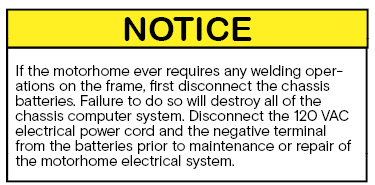
If the batteries are not going to be used for an extended period, remove them from the motorhome and store in a warm, dry place. Tiffin Motorhomes recommends that this service be performed by a qualified service technician, as the process is usually too complicated for the average owner to perform. For those who might wish to perform this service themselves, use the following procedure: Mark the battery cables (“+” sign or “red” for the positive cable; “-” sign or “black” for the negative cable) so that they can be properly reconnected again later. These batteries require periodic recharging to maintain their full charge. Over time, the flooded lead-acid batteries will lose some of the water used with the sulfuric acid in the batteries. Following manufacturer’s recommendations as found in the Tiffin Knowledge Base Owner’s Hub, periodically check the fluid levels in all the cells of the batteries (be sure to use safety eyewear during this process) and fill those that are low with water (distilled or deionized water is preferred; tap water is okay). Do not overfill the cells; follow the filling directions exactly. Check the battery on a regular basis to realize the fullest service possible from the batteries over the longest time possible. If the motorhome is to be stored for an extended period, disconnect the 12 VDC battery system—this procedure will prevent unnecessary drain and corrosion of the batteries and their terminals.



HOUSE BATTERY DISCONNECT PANEL:
The house battery disconnect panel (Figure: 9- 8) is located in the cargo storage area on the driver side. Along with the inverter switch and several breakers, the rotary switch labeled House Battery Master Switch can disconnect the house batteries when the vehicle is in storage for long periods.
Rotating this switch disconnects the house batteries only, not the engine batteries. This feature is designed to disconnect all 12 VDC circuitry from the batteries and prevent them from being drained during storage.

ENGINE BATTERY DISCONNECT:
The engine battery disconnect switch is located in the exterior battery storage compartment, on the rear of the passenger’s side of the motorhome. On the upper, right-hand side of that compartment is another rotary switch (Figure: 9-9) which, when activated, disconnects the “engine” batteries. When the motorhome is to be stored for any length of time, it is wise to disconnect these two 12 VDC systems. When the motorhome is removed from storage, rotate the upper, right-hand disconnect switch to reconnect the 12 VDC power. Tiffin Motorhomes recommends disconnecting the engine batteries while servicing the motorhome.

12 VOLT DC DISCONNECT SWITCH:
For routine, short-term use, there is a “12 VDC disconnect” switch on the switch console located in the stairwell of the Zephyr (Figure: 9-10). This switch—located at the bottom of the switch console—can be used to disconnect the “house” battery from most of the 12 VDC circuits in the motorhome so that there is no inadvertent drain on the battery while the owner is away from the motorhome (e.g., shopping trips, day trips for sightseeing). The motorhome may be equipped with a battery maintainer (Figure: 9-11) that automatically activates when the motorhome is plugged into shore power to maintain charge in the AGM house batteries as shown in (Figure 9-6).


12 VOLT DC (VDC) RECEPTACLES:
The motorhome is equipped with a 12 VDC receptacle (Figure: 9-12) is located on the driver’s side console. Also, this receptacle can be located on the passenger’s exterior side in the portable fridge/freezer storage bay (Figure: 9-13) This 12 VDC receptacle can be used for providing power to portable electrical devices and can accommodate cigarette-lighter” type of connector.


USB RECEPTACLES:
The motorhome is equipped with USB ports (Figure 9-14) conveniently located on the front instrument panel, and in the bedroom, and on the passenger console. These ports allow for easy access when charging portable electronic devices.

CONVERTER/INVERTER:
When the 120 VAC power is not available, either from the power cord or from the generator, the inverter/charger may be used. The inverter/charger (Figure 9-15) has two modes of operation: INVERTER (providing power to your appliances from the batteries) and AC (running from shore power or a generator). Whenever the inverter is in AC mode, it passes power directly to your appliances as well as recharges the batteries using a three-stage battery charger (Bulk, Absorption, and Float). This approach to battery charging provides rapid and complete charging cycles without placing undue stress on the batteries. Inverter operation (Figure: 9-16) is enabled with the Spyder Inverter Control Panel (Figure 9-17 and Figure 9-18). With search mode enabled, the inverter pulses the AC output looking for an electrical appliance (typically 5 to 100 watts, depending upon the setting you have selected).


When there is no load detected, the inverter automatically goes into search mode (sleep) to minimize energy consumption. During this time, the inverter’s green LED flashes (fast) to indicate SEARCH mode. When an appliance is switched on inside the coach, the inverter recognizes the need for power and automatically starts the inverter.
Whenever AC Shore Power is no longer sensed, the inverter automatically transfers to battery power with no interruption to your appliances. The inverter’s green LED flashes once every 2 seconds (medium flash) to indicate it is running on battery power and providing AC to the coach.
Whenever AC Shore Power is sensed, the inverter automatically transfers to the shore power with minimal interruption to your appliances.
Whenever the inverter is running on nominal AC shore power, it charges the batteries. The inverter’s green LED stays ON (solid) to indicate the first stage of charging, as shown in Figure 9-16. During bulk charging, the charger supplies the maximum amount of constant current to the batteries. As the battery voltage rises to a set value, the charger will then switch to the next charging mode. As the inverter continues to run on nominal AC Shore Power, and the batteries have been successfully bulk charged, the charger enters its second stage of charging. The inverter’s green LED flashes once every second (fast flash) to indicate absorption charging for 1-3 hours depending upon the battery bank selection. The charger then switches to its final mode.
As AC shore power continues the inverter’s green LED flashes once every 8 seconds (slow flash) to indicate the third and final stage of charging. The batteries are held at the float voltage as long as AC is present at the inverter’s input. Float charging reduces battery gassing, minimizes watering requirements (for flooded batteries), and ensures that the batteries are maintained at optimum capacity. The inverter monitors the AC Shore Power, the batteries, and itself. Whenever a condition occurs that is outside the normal operating parameters, the inverter will take the necessary steps to protect your appliances, batteries, or itself from damage. Whenever the battery voltage reaches a low level, the inverter will initiate Low Battery Cut-Off (LBCO), which automatically shuts the inverter down, along with all connected loads, to protect the batteries from over-discharge damage. The inverter’s LED turns OFF to indicate the fault condition. As the inverter is charging, it constantly monitors the batteries. If the battery voltage level becomes too high, it automatically turns off the battery charger to protect the batteries from damage. The inverter’s LED turns OFF to indicate the fault condition.
NOTE: High battery voltage might be caused by excessive voltage from the alternator, solar panels, or other external charging sources.
During inverter and AC Shore Power operation, the inverter monitors the AC and DC circuits. In the event of a short-circuit or overload condition, the inverter will shut down. The inverter’s LED turns OFF to indicate the fault condition. During inverter operation, if the inverter becomes overheated, it will shut down to protect itself from damage. The inverter’s LED turns OFF to indicate the fault condition. For further reading and additional information on the above, reference your inverter/charger manual that will be found in your Tiffin Knowledge Base Owner’s Hub.
120 VOLT (VAC) AC RECEPTACLES:
The motorhome is equipped with several 120 VAC receptacles (Figure: 9-19) located throughout the interior of the motorhome. These 120 VAC receptacles are of the “three-prong” variety; the third prong being a grounding pin that provides adequate grounding to protect one from any electrical shock.

For these receptacles to work properly, do not use an adapter, cheater, or extension cord, which defeats the function of the grounding pin. For the same reason, never remove or bend away the ground prong or pin from any three-prong AC plug so that it would fit a two-prong AC receptacle (i.e., an ungrounded AC receptacle).
Never operate the motorhome if there is an electrical short present, as an electrical short might deliver an electrical shock to anyone encountering the exterior of the unit.
If you feel even the slightest of electrical shock, immediately disconnect the unit from the 120 VAC power source and locate the electrical fault (i.e., typically, it is a break in the grounding circuit).
Do not reconnect the 120 VAC power until after the electrical fault is fixed—the grounding circuit must be continuous from the frame to the distribution panel, to the power cord, and to the earth ground so that electrical-shock protection is realized.
GROUND-FAULT-CIRCUIT-INTERRUPT RECEPTACLES:
In the kitchen and bath areas, there are 120 VAC GFCI receptacles (Figure: 9-20), which provide greater protection against inadvertent electrical shocks. These specialized GFCI receptacles provide both overload and short-circuit protection for the user. The electrical receptacles located in the slide-out are wired through the kitchen GFCI. The exterior receptacles are wired through the bathroom GFCI. Consequently, if an appliance plugged into a slide-out or exterior receptacle is not working, check for a tripped GFCI in the kitchen or bathroom.

All GFCI protected receptacles are marked as such, but only one of them might have two pushbuttons on the receptacle (as shown in the picture). The upper pushbutton is a “test” button, which can be used to ensure that the GFCI function is working.
To reset this GFCI breaker, push the lower button (the “reset” button) to restore power to all the GFCI receptacles on this circuit. These receptacles protect the user from ground faults between an electrically “hot” wire and ground. The GFCI will not reduce the shock hazard if the short is between a neutral and “hot” wire, or two “hot load” wires. The GFCI must be tested at least once a month. The 120 VAC electrical system must be ON for the GFCI to be tested.
To test the GFCI, the reset button must be pushed in fully before starting the test. Push the test button; this will cause the reset button to pop out, which means that the protected circuits have been disconnected. Push the reset button back in until a “click” is heard—this will reactivate the protected circuit. If the GFCI is working properly, the reset button will remain in the “in” position.
POP-UP 120 VOLT/USB PORTS:
In the Kitchen/Dinette area, the Zephyr is equipped with a pop-up electrical panel that provides two 120-volt outlets and two USB ports, as shown in (Figure: 9-21).

ELECTRICAL GENERATOR:
The Zephyr uses a 10.0 KW electrical generator (Figure: 9-22), which is conveniently located by opening the front hood of the motorhome.

Before starting or stopping the generator, make sure that all the 120 VAC appliances are turned OFF.
After the generator has been started, wait until the transfer switch has connected before turning ON any of the appliances.
The generator can be started from either the remote-start switch located on the dash or directly at the generator itself. The hour meter installed on the generator records the number of hours of operation of the generator motor—this elapsed time is needed for observing necessary maintenance schedules on the generator.
For more detailed operating instructions and to determine necessary preventive maintenance schedules and procedures, review the manufacturer’s owner’s manual.
ENERGY MANAGEMENT SYSTEM:
The energy management system (EMS) (Figure: 9-23) distributes all the 120 VAC power throughout the motorhome, whether it comes from the shore power, the generator, or the inverter. The EMS monitors the incoming power and manages the power to reduce circuit breaker tripping. It does this by briefly shedding power to the loads under its control when the user turns on other more critical appliances in the motorhome. EMS restores power when the appliance is turned off. The EMS panel displays the status of incoming power and the controlled loads.

When coupled with an inverter, EMS reduces battery charge rate before shedding any loads. Working together, an inverter assist feature is available. Normally the inverter is at rest when shore power is available. EMS utilizes the inverter and the coach battery bank to smooth out peak load demands. The inverter assist feature scales back the charge rate to have more 120 VAC power available for the appliances.
ELECTRICAL POWER CORD REEL:
The electric power cord reel (Figure: 9-24) enables you to manually extract the power cord. To retract the power cord, hold the switch until the power cord is fully retracted.

AUTOMATIC TRANSFER SWITCH:
The automatic transfer box (Figure: 9-25) switches 120V AC power from the shore or generator to the motorhome’s main distribution panel. The transfer box has a delay of around three seconds before switching power to the shore, and a delay of around 30 seconds before switching power to the generator. If the unit is plugged into the shore but there is no power to the coach, then make sure the shore outlet has power. If power is present, this might indicate that the unit is sensing an open neutral condition. Start the generator; if the power is restored, then either the shore plug, or the outlet might be defective (the neutral line might be broken).

CIRCUIT BREAKERS:
The 12 VDC circuit breakers ( Figure: 9-26) are located in an external storage compartment. When the circuit breakers are shut down or electrically tripped, they must be manually reset by using the main touch panel. These breakers protect various electrical components throughout the motorhome. As needed, manually reset the circuit breaker or breakers as shown in the accompanying figure. When the breaker is tripped, it will be extended outward. To reset it, push the button back in.

FUSE BLOCKS:
Some of the electrical circuitry within the motorhome is protected by various fusing systems. These fuse blocks protect some of the major electrical systems of immediate concern to the driver. The electrical circuits protected by the under-dash fuse block include headlights, panel light for dashboard, taillights, optional jacks, turn signals, cruise control, engine computer, accessory fuses, heater, and dash air conditioning. Additionally, there is another chassis fuse panel that works in conjunction with the chassis fuse panel and provides comparable protection for the above-listed circuits.


SEVEN-PIN TOWING CONNECTOR:
The motorhome is equipped with a standard, 7-pin connector near the towing hitch at the rear of the motorhome to supply the necessary circuitry to control a towed vehicle. The wiring of that connector is shown in the accompanying diagram (Figure: 9-27).

Make sure that any cable from the vehicle to be towed is wired correctly to mate properly with the connections shown in the connector. If in doubt about proper wiring, have a qualified service technician prepare and install the necessary cable to mate with the 7-pin connector on the motorhome to ensure proper operation subsequently when any vehicle is towed by the motorhome. When the towed vehicle is uncoupled from the motorhome and the cable is disconnected from the 7-pin connector, be sure to close the spring-hinged cover plate on the connector to protect the contact pins from dirt or debris. In a similar manner, protect the cable end from weather, or debris. One method could be to place the connector end in a heavy-gauge plastic bag (e.g., polypropylene, polyethylene, etc.), Secure the bag tightly around the cable with a stout elastic band or tape, and then mount the secured cable in a manner to keep it both from mechanical damage and water intrusion. When the towed vehicle is again coupled to the motorhome through the towing hitch and the cable is again connected to the 7-pin connector, make sure the resultant connection is tight and solid so that the connection does not jar loose during use. Several supplemental methods to secure that connection have been used; some of which include securing the connection with a strong rubber band or with Velcro-type fasteners to provide a supplemental mechanical backup to the actual electromechanical connection. If a conversion adapter to convert the round, 7-pin connector to a flat, 4-pin connector is needed, purchase one from any RV after-market store.
ELECTRICAL DIAGRAM LOCATION LINK: