

RVMP Flex Power 3200d Owner's Manual


Introduction
The RVMP® Flex Power® line of generators can power various RV appliances including AC motors, air conditioners, refrigerators, AC/DC converters and many other RV appliances. The load on the generator depends on the power rating. The generator will shut down or its circuit breaker(s) will trip if the sum of the loads exceeds the power limit of the
generator.
For information on the assembly or individual components of this product, please visit: www.rvmp.co or email us at support@rvmp.com.
NOTE: Images used in this document are for reference only when assembling, installing and/or operating this product.
Actual appearance of provided and/or purchased parts and assemblies may differ.
Safety
Read and understand all instructions before installing or operating this product. Adhere to all safety labels. This manual provides general instructions. Many variables can change the circumstances of the instructions, i.e., the degree of difficulty, operation and ability of the individual performing the instructions. This manual cannot begin to plot out instructions for every possibility, but provides the general instructions, as necessary, for effectively interfacing with the device, product or system. Failure to correctly follow the provided instructions may result in death, serious personal injury, severe product and/or property damage.

Keep multi-class ABC fire extinguishers handy. Class A fires involve ordinary combustible materials such as wood and cloth. Class B fires involve combustible and flammable liquid fuels and gaseous fuels. Class C fires involve live electrical equipment.

The "WARNING" symbol above is a sign that a procedure has a safety risk involved and may cause death or serious personal injury if not performed safely and within the parameters set forth in this manual.

Failure to follow instructions provide in this manual may result in death, serious personal injury and/or severe product and property damage, including voiding of the warranty.

Do not operate equipment when mentally or physically fatigued or after consuming alcohol or drugs.

Do not use starting fluids which can cause an explosion and may result in death, serious personal injury and/or severe product and property damage.

Installing or maintaining a generator can cause severe personal injury when not done correctly. Wear personal protective equipment including safety glasses, hard hats, steel-toes shoes and protective clothing when working on equipment.

Benzene, found in some fuels, and used engine oils have been identified by some state and federal authorities cause cancer or reproductive toxicity. Do no ingest, breathe fumes or come into contact with gas or oil when checking, draining or adding gas and oil.

Hot, moving and electrically-live parts can result in death, serious personal injury and/or severe product and property damage. Only trained and experienced personnel should make adjustments while the generator is running.

Moving parts can catch on loose clothing items or jewelry. Do not wear loose clothing or jewelry near moving parts including shafts, fans, belts and pulleys. Keep hands away from moving parts. Keep protective guards in place over fans, belts, pulleys and other moving parts.

Improperly installed electrical connections may result in death, serious personal injury and/or severe product and property damage. Electrical connections must be made by trained and experienced electricians in accordance with applicable NEC or other codes.

Back-feeding to shore power may result in death, serious personal injury and/or severe product and property damage. The generator must not be connected to shore power or any other source of electrical power, or any RV with shore power capability, unless an approved switching devic e is used to prevent interconnections.

Do not use evaporative starting fluids. They are highly explosive and dangerous.

Operating, servicing, and maintaining this equipment can expose you to chemicals, including engine exhaust, carbon monoxide, phthalates, and lead, which are known to the State of California to cause cancer and birth defects or other reproductive harm. To minimize exposure, avoid breathing exhaust, do not idle the engine except as necessary, service your equipment in a well-ventilated area and wear gloves or wash your hands frequently when servicing your equipment. For more information go to www.P65Warlnings.ca.gov.

The "CAUTION" symbol above is a sign that a procedure has a safety risk involved and may cause personal injury, product or properly damage if not performed safely and within parameters set forth in this manual.

Always wear ey protection when performing service, maintenance or installation procedures. Other safety equipment to consider would be hearing protection, gloves and possibly a full face shield, depending on the nature of the task.
General Guidelines
- Keep children away from the generator
- To prevent accidental or remote starting while working on the generator, disconnect the negative (-) battery cable at the battery.
- Keep the generator and its compartment clean. Excess oil and oily rags can catch fire. Dirt and gear stowed in the compartment can restrict cooling air.
- Make sure all installed fasteners have been secured and torqued properly.
- Do not work on the generator when mentally or physically fatigued or after consuming alcohol or drugs.
- Do not work on the generator when mentally or physically fatigued or after consuming alcohol or drugs.
- Used engine oil has been identified by some state and federal agencies as causing cancer or reproductive toxicity. Do not ingest, inhale or allow bare skin to come in contact with used oil or its vapors.
- Benzene and lead in some gasoline mixtures have been identified by some state and federal agencies as causing cancer or reproductive toxicity. Do not ingest, inhale or allow bare skin to come into contact with gasoline or its vapors.
- Keep multi-class ABC fire extinguishers handy, Class A fires involve ordinary combustible materials such as wood and cloth; Class B fires involve combustible and flammable liquid fuels and gaseous fuels; Class C fires involve live electrical equipment
- Installation and operation of the generator must comply with all applicable local, state and federal codes and regulations.
The Exhaust Produced By The Generator Is Deadly

Substances in combustion exhaust gasses have been identified by some state and federal agencies to cause cancer or reproductive toxicity. Do not breathe in or come into contact with exhaust gasses.

Carbon monoxide is produced as part of the combustion process and is a poisonous gas. Inhalation of this gas can cause serious personal injury or death. Make sure carbon monoxide is not being inhaled by occupants of the vehicle as well as others working on or around the generator.
1. Learn the symptoms of carbon monoxide poisoning. Carbon monoxide is colorless, odorless, tasteless and non-irritating. It cannot be seen or smelled. Exposure to even low levels of carbon monoxide for a prolonged period can lead to asphyxiation. Mild effects of carbon monoxide poisoning include headache, dizziness, drowsiness, fatigue, chest pain and confusion. More extreme symptoms include vomiting, seizure and loss of consciousness.
2. Never sleep in the vehicle while the generator is running unless the vehicle is equipped with a working carbon monoxide detector.
3. Make sure there is ample fresh air when operating the generator in a confined area.
4. Disable any automatic starting feature of an inverter-charger or other automatic starting device before storing the vehicle or parking it in a garage or other confined space.
5. The exhaust system must be installed in accordance with the Flex Power Generator Installation Manual. (available here: https://rvmp.com/manuals).
6. Engine cooling air must not be used for heating the working or living space or compartment.
Diesel is Flammable And Explosive

Fuel and fuel vapor are highly explosive. Do not smoke or turn electrical switches on or off where fuel fumes are present or in areas sharing ventilation with fuel tanks or equipment. Keep flame, sparks, pilot lights, arc-producing equipment and all other sources of ignition well away from fuel lines and fuel sources. Fuel lines must be secured, free or leaks and separated and/or shielded from electrical wiring.
- Fuel leaks can lead to explosive accumulations of gas or vapor.
- LP sinks when released and can accumulate inside housings, basements and other below-grade spaces.
Generator AC Output Voltage Is Dangerous

The generator must not be connected to shore power or to any other source of electrical power without the use of an approved transfer switch. Connecting the generator to utility power during a power outage can cause electric shock, resulting in severe personal injury or death, as well as damage to equipment.
- Disable any automatic starting feature of an inverter-charger or other automatic starting device before servicing the generator.
- Generator electrical output connections must be made by a trained and experienced electrician and in accordance with applicable codes.
- Use caution when working on live electrical equipment. Remove jewelry, make sure clothing and shoes are dry, stand on a dry wooden platform or rubber insulating mat and use tools with insulated handles.
Gas Emitted From Batteries Is Explosive

Battery gas is highly explosive and may result in death, serious personal injury and/or severe product and property damage. Battery compartments must be adequately ventilated per RVIA guidelines (see RVIA/NFPA 1192 Section 2-3). Wear appropriate personal protective equipment when working on the battery and do not smoke around the battery. Disconnect the negative battery cable first and reconnect it last.
- Wear safety glasses
- Do not smoke.
- To reduce arcing when disconnecting or reconnecting battery cables, always disconnect the negative (-) battery cable first and reconnect it last.
Moving Parts Can Cause Injury

Hot, moving, and electrically-live parts can result in death, serious personal injury and/or severe product and property damage. Make sure protective guards are in place, use trained personnel to make adjustments and do not wear loose clothing near moving parts.
- Make sure all protective guards are property installed before starting the generator.
- Use only trained personnel to make adjustments to the generator while it is running.
- Moving parts can catch loose items, such as clothing or jewelry. Do no wear loose clothing or jewelry near moving parts such as power take-off shafts, fans, belts and pulley.
- Moving parts can entangle appendages, including fingers. Keep the protective guards in place over the fans, belts, pulleys and other moving parts and keep hands away from all moving parts.
Model Identification
A nameplate containing the model and serial number of the generator is affixed to the front of the generator. This information is necessary when contracting RVMP for parts, service and product information. Contact RVMP at support@rvmp.com or through www.rvmp.co.
2. General Information
Information on the document
This manual was created with due care. It is exclusively intended to offer a technical description of the machine and to provide instructions on commissioning, operating and maintaining the machine. When operating the machine, the applicable standards and legal regulations as well as any in-hours regulations apply.
Before commissioning, during operation and before maintenance work is begun on the machine, read this manual carefully and keep it close by the ready access.
Machine
This manual describe the following machine:

Exclusion of liability
The manufacturer cannot be held liable for personal injury, damage to property or damage to the machine itself caused by improper use, foreseeable misuse, or failure to follow or adequately follow the safety measures and procedures described in this manual. This also applies to changes made to the machine and the use of unsuitable spare parts. Modifications, which serve the technical improvements, are reserved.
Customer service
Have service work performed by qualified technicians only. We recommend that you work with one of the over 500 RVMP service stations. Trained specialist there will repair your machine with genuine RVMP spare pars and with RVMP tools. The global RVMP service network is at your disposal to advise yu and supply you with spare parts. The address of your nearest RVMP Service can be found on: www.rvmp.co
Installation of unsuitable spare parts can lead to problems. We cannot accept liability for direct damage or secondary damage that results from this. We therefore recommend the use of genuine RVMP spare parts. These parts are manufactured according to strict RVMP specifications and achieve maximum operational reliability through their perfect fit and functionality.
3. Safety
3.1 General Information
This section contains the information you need to work safely with this machine. To prevent accidents and damage to the the machine, it is imperative that these safety instructions be followed. Read this section carefully before beginning work.
3.1.1 Intended use
The machine described in this Operator's Manual fulfills the following functions:
- Power supply and current strength as per technical data (see Section 4.2.3 Inverter).
This generating set is only approved for use in mobile homes. Any other use is not intended and therefore not permitted. In this case, the safety of people located in the vicinity of the machine may be impaired. RVMP does not accept any liability for harm resulting from this. The generating set fulfills the basic protection measure of protective separation with equipotential bonding (ungrounded system). A personal protection Device must be integrated in the wiring between the generating set and the AC power connection in the mobile home. It interrupts the current supply to the power sockets if an electrical fault occurs in the system. The personal protection device must meet local regulations.
The operational safety of the machine is only guaranteed if it is used as intended.
The intended use also includes observance of the instructions in this Operator's Manual to preserve the environment, including in the appendix for the model year 2025 as per EPA Nonroad Diesel Engines and for the model year 2025 CARB-certified heavy-duty-off-road engines.
Foreseeable Misuse
The following is considered to be foreseeable misuse:
- Any use that varies from or extends beyond the uses specified above.
- Failure to comply with the instructions in this Operator's Manual.
- Failure to comply with the safety instructions.
- Failure to immediately eliminate malfunctions that impact safety before continuing work with the machine (working with the machine when it is not in perfect condition, either functionally or in terms of safety).
- Fuel other than specified in the instructions.
- Failure to perform the necessary inspection and maintenance work.
- Any unauthorized modification of or removal of safety equipment.
- Use of spare parts and accessories that are unsuitable or have not been approved by RVMP Flex Power
- Operation in flammable or hazardous environments
- Operation in closed-off or poorly ventilated rooms
- Operation in an aggressive atmosphere (e.g.; high salt content) without further measures for corrosion protection.
- The use of engine cooling air to heat the vehicle.
- Connection of electrical consumers that are not suitable for operation with this machine.
- Connection of electrical consumers whose total power consumption exceeds the power rating of the machine.
- Parallel operation with other energy sources (public network, PV units, energy storage unit, other generating sets etc.).
- Use of the machine as a life-support system. the generating set may switch off without warning. Humans or animals that depend on an uninterruptible power supply may become injured or die if the generating set fails.
- Improper operation at variance with ISO 3046-1 and ISO 8528 (climate, load, safety).
- Improper operation at variance with the standards and regulations ANSI/RVIA EGS-1, CSA, Electrical Bulletin 946 (Requirements for Internal Combustion Engine-Driven Electric, generators for Use in Recreational Vehicles), NFPA No. 1192 (Recreational Vehicles), NFPA No. 70, Article 551 - (Recreational Vehicles and Recreational Vehicle Parks).
Residual risks
Residual risk will be pointed out in Section 3.2.2 Machine-specific safely instructions for operation, (Section 3.2.3) Machine specific safety instructions for maintenance work, as well as in the further contents of the manual, directly in front of the descriptions or operating instructions concerned.
3.2.1 Obligations of the operator
User obligations
The operator is obliged to only operate the machine when it is in perfect condition. the operator must check the condition of the machine before use and ensure that any defects are eliminated before it is taken into service. Running the machine while identified defects exist is not permitted. The operator must also ensure that all persons who work on the machine are familiar with the contents of this manual.
Obligations of operating and maintenance personnel
Personnel assigned with operating and maintaining the machine must have read and understood this manual or must possess the qualifications necessary for working with this equipment, acquired in training/instructional courses. No one may work with the machine without the necessary qualifications, even if for just a brief period.
The operating and maintenance personnel must not be under the influence of drugs, medication or alcohol.
All work performed on the machine must be in compliance with the information provided in this manual.
Storing the operator manual
These instructions and the associated documents are an integral part of this machine (including when sold). They must be stored in the direct vicinity of the machine and be accessible to personnel at all times.
3.1.3 Representation of safety notes
Overview
This machine has been designed and built according to state-of-the-art technology and the recognized safety standards. Despite these precautions, risks exist when operating the machine and during maintenance work.
These risks are identified in this manual by means of safety notes. The safety notes precede the relevant description or operating step.
The structure of the safety notes
- Danger symbol
- Signal word
- Description of the danger
- Possible consequences
- Preventative measures
General danger symbol
 The general danger symbol is used to identify the danger of personal injury.
Signal words
Signal word identify the magnitude of the risk and the seriousness of possible injury:

3.1.4 Meaning of safety symbols
Explanation of safety symbols
The following table describes the meanings of the safety symbols used in this Operator's Manual


3.2 Safety notes
3.2.1 Operational safety
Introduction
This section contains all of the important safety instructions for personal protection and for safe and reliable operation. Additional, task-related safety instructions can be found at the beginning of each section.

Using the machine
- Only operate the machine for the purposes described in Section 3.1.1 Intended use.
Compliance with other regulations
- The applicable regulations of the relevant professional associations must be observed.
- In addition, local safety, accident prevention and environmental regulations also apply when operating the machine.
Personal protective equipment
During operation and maintenance of th machine, personal protective equipment must be available and must be used if necessary. The use of personal protective equipment is specified in the description of the operating steps.

Warning labels and information signs on the machine
The warning labels and information signs on the machine must be followed (see Section3.3).
The warning labels and information signs must be kept legible and must be replaced if necessary. For this purpose, contact RVMP Customer Support at support@rvmp.co or 855-427-7978
Maintenance work
Maintenance work that goes beyond the scope described in this manual must only be performed by qualified technicians (see section Customer service).
Independent maintenance work and constructional changes to the machine, especially to the safety equipment, are not permitted.
Safety equipment
Safety equipment must not be modified and must not be rendered ineffective during normal operation.
General safety instructions

- Before switching on the machine, ensure that no one can be injured when the machine is started up.
- During machine operation, ensure that unauthorized persons do not have access to the area in which the machine has an impact.
Machine
- The outlet for cooling air and exhaust gas becomes hot during operation.
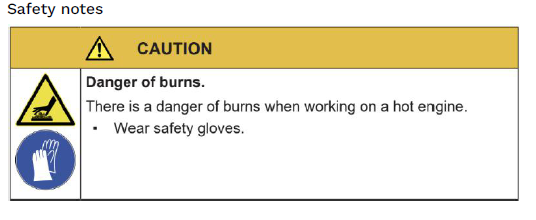
- Risk of injury from touching hot parts! Let the engine cool before maintenance.
- Do not refuel during operation.
Faults
- Immediately eliminate faults that compromise safety.
- Switch off the machine and do not take into service again until all faults have been eliminated.
Safety instructions for operation


3.2.3 Machine-specific safety instructions for maintenance work
Introduction
The machine can pose residual risks during maintenance. To eliminate these risks, all persons working on the machine must follow the general and machine-specific safety instructions.
Maintenance work
Maintenance work that goes beyond the scope described in this manual must only be performed by qualified technicians. We recommend that you work with one of the over 500 RVMP Flex Power service stations.
Replacing parts
- When replacing defective components, we recommend that you use RVMP Flex Power spare parts (see section Customer service).
- When disposing of parts that can no longer be used, do so in accordance
- with local environmental regulations or send them to a recycling center.
Measures following maintenance and troubleshooting
- Securely reconnect loose electrical connections; check that the electrical components and equipment are functioning properly.
- Check the entire machine for foreign bodies; remove any foreign bodies.
Safety instructions for maintenance work


3.2.3 Electrical equipment
Safety notes


- To avoid the danger of electric shock during an unexpected start, note the following points before beginning work:
- Switch off the operating panel, press the stop switch and disconnect the battery cable negative terminal (B-) from the generating set; see Section 8.2.2 Before beginning maintenance work.
- The electrical output of the generator must be connected by a qualified electrician in accordance with local regulations.
- The generating set is not permitted to be connected to the power grid. Feeding power back into the power grid can lead to electric shocks and damage to the equipment. An approved switching device must be used that prevents interconnection with the power grid.
- Do not disconnect the battery while the machine is running. Resulting voltage peaks could destroy the electronic components.
- Do not use a water jet or high pressure cleaner to clean the machine.

3.3 Labels
Warning labels and information signs on the machine.


4.1 Generating set
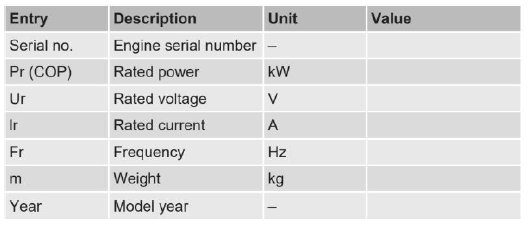
Machine type plate

Please enter the data from the type plate into the following table to ensure you have access to the data even in the event of loss or damage.
Dimensions and weight


Noise data

Explosion protection
This machine does not feature explosion protection
4. Components
Overview
The machine consists of the following main components

4.2.1 Engine
Engine type plate

The layout of the EPA/CARB type plate depends on the engine application and is affixed to the air filter cover. It contains the following information:

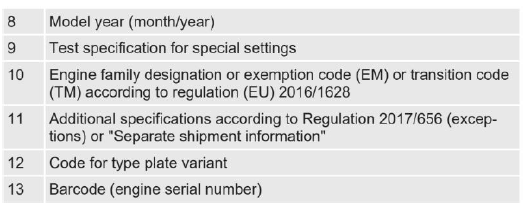
The type plate also defines the applicable emissions-related performance class of the engine.
The figure shows an EPA/CARB type plate.
A text that refers to the exhaust legislation and corresponds to the engine type is printed on the type plate (EPA or EPA and CARB).
The following data must always be specified in case of queries and for spare pars orders:

Technical data


These specifications are approximate values. The max. mark on the dipstick is decisive in any case (see section Checking the oil level and adding oil if necessary).
Engine oil
Oil quality
All oil brands that meet at least one of the following specifications are suitable:

Oil viscosity

Choose the recommended viscosity based on the type of start (recoil, crank handle or electric) and on the engine temperature at which the engine will be operated.

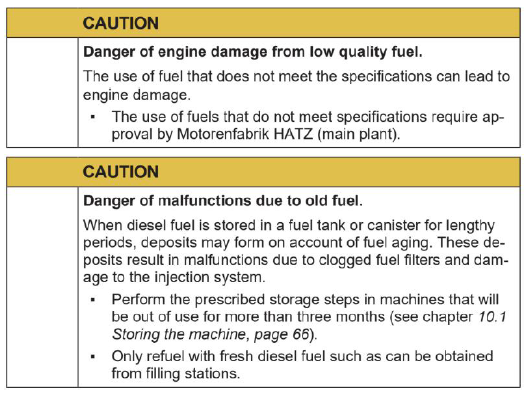
Fuel
Fuel type
All types of diesel fuel that meet the minimum requirements of the following specifications are suitable:
● Europe: EN 590
● UK: BS 2869 A1 / A2
● USA: ASTM D 975-09a 1-D S15 or 2-D S15
Winter fuel
Diesel fuel loses its fluidity at low temperatures, which can lead to operating problems. Use cold-resistant
winter diesel fuel for outside temperatures below 0 °C.
4.2.2 Alternator
Technical data

4.2.3 Inverter
Technical data

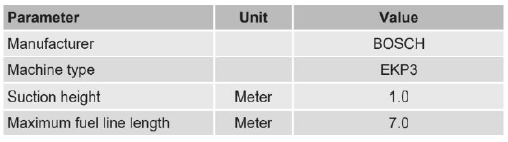
4.2.4 Fuel pump
Technical data
5 Configuration and function
5.1 Machine overview

Use
The machine is used to generate current for the operation of electrical machines with alternating voltages
and frequencies as specified on the machine type plate. The engine, alternator, inverter, and fuel pump are
secured in an enclosed and soundproof housing.
Functional procedure
The engine powers a permanent magnet alternator integrated in the flywheel. The inverter regulates the
alternating current in the generator to the necessary voltage and frequency.
5.2 Mechanical components

5.3 Electrical components
Overview of electrical components
● Alternator with electrical equipment
● Control panel

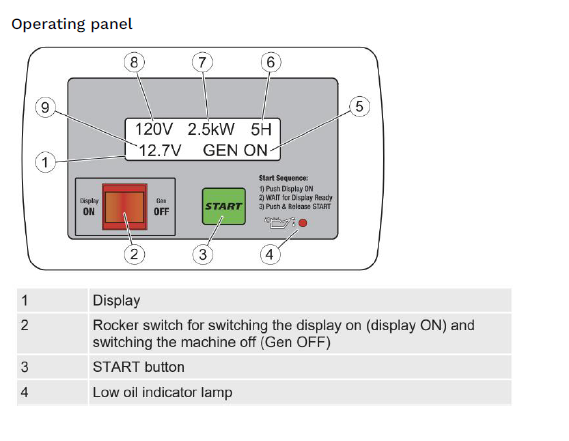
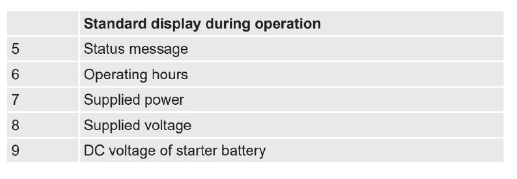
The control panel has the purpose of displaying and monitoring all important functions. The integrated fault
diagnosis system makes it easier to locate faults. The maintenance indicator indicates when maintenance
work is due. For more information, see Section 9.2 Display messages..
6 Transport
6.1 Transport
For lifting and transporting the machine, see installation instructions.
6.2 Filling engine oil (first filling)
Engines are normally delivered without an engine oil filling.


7 Operation and use
7.2 Safety notes

7.2 Load limits
The generating set can supply AC motors, air conditioners, AC/DC converters, battery chargers and other
machines. How many machines can be supplied depends on the generator output. The generating set
switches off if the sum of the loads exceeds the generator output (see Section 9.1 Fault table).
To prevent overloading of the generating set and the associated switch-offs, compare the sum of the loads
of the machines that likely to be used simultaneously with the rated output of the generating set.
The generating set may switch off due to overloading if a large motor or an air conditioner is started or
switched off and on again, even though the sum of loads is less than the rated output of the generating set.
The reason is that the starting load of a motor is larger than its operating load. It may be necessary to
operate fewer machines if large motors and air conditioners are being switched on and off.

The engine output decreases as the ambient temperature and/or the altitude increases. Therefore, it may be
necessary to operate fewer machines under these conditions.
Reduction in output with increasing ambient temperature
At ambient temperatures of more than 25 °C (77 °F), the rated engine output drops by approx. 6% every
5.5°C (42 °F).

7.3 Performing tests
Before starting
Before starting the machine, several tests need to be performed to ensure the machine is working properly

7.4 Operating the generating set

Symptoms of carbon monoxide poisoning
Among the symptoms of carbon monoxide poisoning are:
● Dizziness
● Headache
● Nausea
● Weakness and sleepiness
● Vomiting
● Light-headedness
If one or more of these symptoms occur, immediately go out into the fresh air. If symptoms persist, consult a
physician.
Switch off the generating set and do not operate again until it has been inspected and repaired.
7.4.1 Starting the generating set


7.4.2 Stopping the generating set


8 Maintenance
8.1 General maintenance instructions

● Maintenance tasks may only be performed by trained personnel.
● Adhere to the accident prevention measures in accordance with the local accident prevention
regulations.
● Perform setting and maintenance work at the specified intervals.
● Replace defective machine parts as soon as possible.
● Always wear personal protection equipment.
● Only use fully functional tools.
● Installation of unsuitable spare parts can lead to problems. We cannot accept liability for direct damage
or secondary damage that results from this. We therefore recommend the use of genuine RVMP spare
parts.
● Closely adhere to the maintenance conditions prescribed in this Operator's Manual.
● Only make changes to the machine in agreement with the manufacturer.
● Only perform maintenance work when the engine is switched off.
● Adhere to legal regulations when handling and disposing of used oil, filters, and cleaning agents.
● Disconnect the negative battery terminal.
● After completing maintenance work, check that all tools, screws, aids, and other objects are removed
from the machine, and that all safety equipment has been replaced.
● Before starting, ensure that no persons are located in the danger zone of the engine or machine.
Performance of maintenance work
The entire machine is designed to be maintenance friendly. Parts that require maintenance are easily
accessible.
● Perform maintenance work faithfully at the specified intervals to prevent premature wear of the machine.
● Follow the notice and warning labels on the machine.
● Always retighten screw connections loosened during maintenance work.
● After the necessary maintenance and repair work is completed, perform a function test (test run).
● For maintenance work that is not listed and described in the maintenance documentation, please
contact your nearest RVMP service station.
8.2 Maintenance work

8.2.1 Maintenance plan


1. The engine control module continuously evaluates the engine-relevant data during operation. If an engine
fault or deviations from the setpoints occur, these data are written to the error memory. Stored data can
be read out and evaluated for fault diagnostics by a RVMP service partner using the RVMP Diagnostic
Software HDS2. In this way, faults can be detected and eliminated early on or preventative maintenance
can be performed.
2. Maintenance according to the maintenance interval or after 12 months, whichever comes first.
3. The engine control unit can only be updated using the RVMP diagnostic software HDS2.The update
installs extensions and improvements of the control software.
4. The interval at which maintenance work should be performed on the fuel filter depends on the
cleanliness of the fuel in use and may need to be short-ened to 150 operating hours.
5. Maintenance according to the maintenance interval or after 4 years, whichever comes first.
8.2.2 Before beginning maintenance work
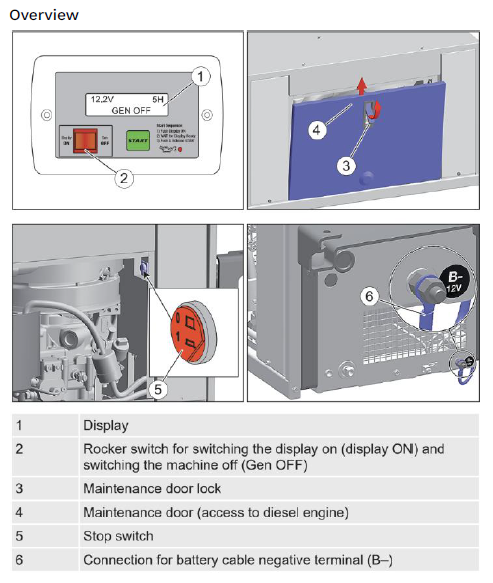

8.2.3 Checking the oil level

Preparation
Protect the machine against being started unintentionally; see Section 8.2.2 before beginning maintenance
work.


8.2.4 Change the engine oil
This section contains the following subsections:
● Preparation
● Draining the engine oil
● Filling the engine oil


Preparation
● Allow the generating set to warm up for three to five minutes so that the engine oil becomes more
fluid and then drains quickly and completely.
● Protect the machine against being started unintentionally; see Section 8.2.2
● Before beginning maintenance work.
Draining the engine oil


Filling the engine oil

8.2.5 Changing the fuel filter

Preparation
Protect the machine against being started unintentionally; see Section 8.2.2 Before beginning maintenance
work.

8.2.6 Maintaining the dry air filter

Preparation
Protect the machine against being started unintentionally; see Section 8.2.2 before beginning maintenance
work.


8.2.7 Checking and cleaning the air filter cartridge


8.2.8 Clean the oil filter


Preparation
Protect the machine against being started unintentionally; see Section 8.2.2 Before beginning maintenance
work.


9 Faults
9.1 Fault table
General troubleshooting notes
If the cases listed below have been worked through but the fault continues to persist, please contact your
nearest RVMP service.

The starter is turning but the engine does not start
The generating set performs up to three start attempts, during which the starter turns for 5 seconds each
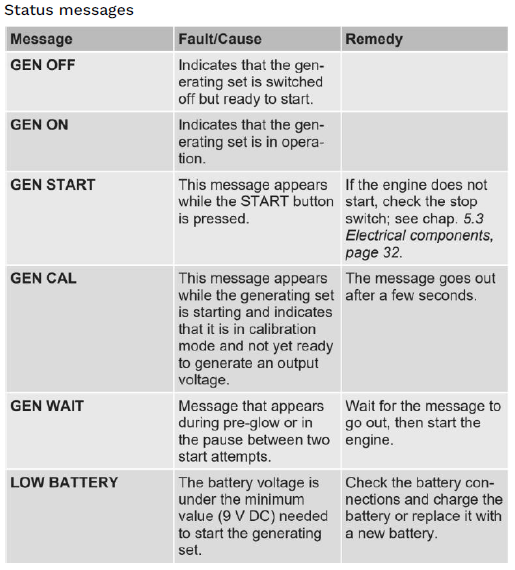
time. The starter pauses for several seconds between start attempts. "GEN WAIT" appears on the display; see
Section 9.2 Display messages.


9.2 Display messages
The following status, warning and error messages appear on the display. Once messages have been deleted,
they cannot be called up again. To delete the errors, switch the operating panel off and on again.


10 Storage and disposal
10.1 Storing the machine


Storing the machine for a lengthy period
Take the following measures if you intend to take the machine out of service for a lengthy period (3–12
months):

Ambient conditions during storage
● Max. permissible storage temperature: -25 °C to +60 °C
● Max. permissible humidity: 70%


The machine new from the factory can normally be stored for up to 12 months. The protection lasts up to
approx. 6 months at very high humidity and in sea air. For storage periods of more than 12 months, please
contact the nearest RVMP Service.
10.2 Disposing of the machine
Disposal of information
Dispose of the machine (including machine parts, engine oil and fuel) according to the local disposal
regulations and the environmental laws in the country of use. Because of the danger of possible
environmental damage, only permit an approved specialist company to dispose of the machine.

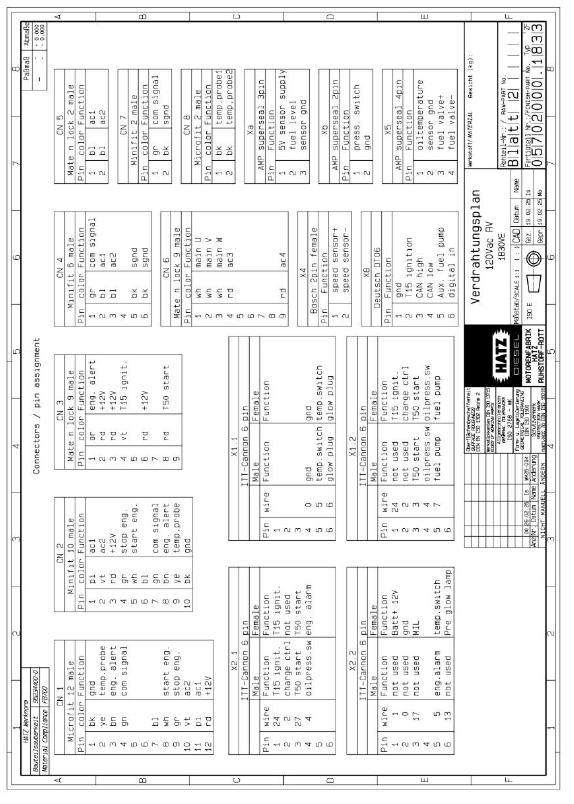
11 Wiring plan

12 EPA AND CARB CERTIFIED ENGINES
SUPPLEMENTAL INFORMATION TO THE OWNER'S MANUAL FOR MODEL YEAR 2025 FOR EPA AND CALIFORNIA
CERTIFIED NONROAD COMPRESSION IGNITION ENGINES.
YOUR WARRANTY RIGHTS AND OBLIGATIONS.
The California Air Resources Board and RVMP Flex Power® is pleased to explain the emission control system
warranty on your Model Year 2025 engine. In California, new heavy-duty off-road engines must be designed,
built, and equipped to meet the State’s stringent anti-smog standards. The RVMP Flex Power® must warrant
the emission control system on your engine for the periods of time listed below provided there has been no
abuse, neglect or improper maintenance of your Engine.
Where a warrantable condition exists, the RVMP Flex Power® will repair your heavy-duty off-road engine at
no cost to you including diagnosis, parts, and labor.
MANUFACTURER’S WARRANTY COVERAGE.
The Model Year 2025 heavy-duty off-road engines are warranted for the periods described below. RVMP Flex
Power® warrants to the original owner, and to each subsequent owner, of a new, diesel engine that the
emission control system of your engine:
● Was designed, built and equipped so as to conform at the time of sale with all applicable regulations of
the California Air Resources Board (CARB).
● Is free from defects in material and workmanship that will cause such engine to fail to conform with
applicable regulations for the following warranty

If any emission-related part on your engine is defective, the part will be repaired or replaced by RVMP Flex
Power®.
The warranty period shall begin:
● On the date the equipment is first delivered to the first retail purchaser, or;
● If the equipment is placed in service for demonstration purposes prior to sale at retail, on the date the
engine is first placed in service. The emission control systems of your new RVMP® engine was designed,
built and tested using genuine RVMP® parts, and the engine is certified as being in conformity with CARB
and US EPA emission control regulations. Accordingly, it is recommended that any replacement parts
used for maintenance, repair or replacement of emission control systems be RVMP® parts. Any
replacement part that is equivalent in all material respects may be used in the performance of any
maintenance or repairs, although RVMP® recommends that the owner obtain assurance that such parts
are warranted by their manufacturer to be equivalent to genuine RVMP Flex Power® parts. Such use shall
not reduce the remaining warranty obligations of the engine manufacturer, provided they are warranted
to be equivalent to genuine RVMP® parts.
● Any warranted part that is not scheduled for replacement, as required maintenance shall be warranted
for the warranty period defined above. If any such part fails during the period of warranty coverage, it will
be repaired or replaced under warranty. Any such part repaired or replaced under the warranty shall be
warranted for the remaining warranty period.
● Any warranted part that is scheduled only for regular inspection in the written instructions shall be
warranted for the warranty period defined above. A statement in the written instructions to the effect of
"repair or replace as necessary" shall not reduce the period of warranty coverage. Any such part repaired
or replaced under warranty shall be warranted for the remaining warranty period.
● Any warranted part that is scheduled for replacement, as required maintenance shall be warranted for
the period of time prior to the first scheduled replacement point for that part. If the part fails prior to
the first scheduled replacement, the part shall be repaired or replaced by the engine manufacturer under
warranty. Any such part repaired or replaced under warranty shall be warranted for the remainder of the
period prior to the first scheduled replacement point for the part.
● Repair or replacement of any warranted part under warranty shall be performed at no charge to the
owner at a warranty station.
● RVMP® provides warranty services or repairs at all manufacturer distribution centers (warranty stations)
that are franchised to service the subject engines. Please see the Customer Assistance section of this
statement for help in locating such service centers.
● The owner will not be charged for diagnostic labor that leads to the determination that a warranted part
is in fact defective, provided that such diagnostic work is performed at a warranty station.
Owners warranty responsibilities
As the engine owner, you are responsible for the performance of the required maintenance listed in your
owner's manual. RVMP® recommends that you retain all receipts covering maintenance on your engine, but
RVMP® cannot deny warranty solely for the lack of receipts or for your failure to ensure the performance of
all scheduled maintenance. As the engine owner, you should be aware, however, that Motorenfabrik RVMP
may deny you warranty coverage if your engine or a part has failed due to abuse, neglect, improper
maintenance or unapproved modifications. Your engine is designed to operate ultra-low sulfur fuel only. Use
of any other fuel may result in your engine no longer operating in compliance with California’s emissions
requirements.
You are responsible for presenting your engine to a RVMP® authorized service center as soon as a problem
exists. The warranty repairs should be completed in a reasonable amount of time, not to exceed 30 days.
Add-on or modified parts, as defined in CCFR Section 1900(b)(1) and (b) (10), Title 13, that are not exempted
by the Air Resources Board may not be used. The use of any non-exempted add-on or modified parts shall
be grounds for disallowing a warranty claim made in accordance with this article. The engine manufacturer
shall not be liable under this article to warrant failures of warranted parts caused by the use of a
non-exempted add-on or modified part.
Customer Assistance
If you have any questions regarding your warranty rights and responsibilities, you should contact RVMP at
(855) 427-7978.
What is Not Covered by the Emission Warranty
Please note that Emission Warranty does not cover:
● Systems and parts that were not first installed on the new equipment or engine as original equipment by
RVMP®.
● Part malfunctions caused by abuse, misuse, improper adjustment, modification, alteration, tampering,
disconnection, improper or inadequate maintenance, or use of non-recommended fuels and lubricating
oils.
● Damage caused by accident, acts of nature, or other events beyond Motorenfabrik RVMP’s control.
● Replacement of expendable items made in connection with scheduled Maintenance.
● Parts requiring replacement, inspection or adjustment during scheduled maintenance intervals where the
part is not defective.
● Parts that are not RVMP® Service Parts.
● Loss of time, inconvenience, loss of use of equipment/engine or commercial loss.
● Equipment with an altered or disconnected hour meter where the hours cannot be determined.
● Equipment normally operated outside the United States.
○ Non-defective parts replaced by other than RVMP® dealers.
What is covered by emission warranty
The following is a list of systems and parts that are considered a part of the Emission Control System and
are covered by the Emission Warranty for engines that were built to conform to EPA and CARB regulations:
Important!
This may not include expendable maintenance items. Emission related parts requiring scheduled
maintenance are warranted until their first scheduled replacement point only.
The following parts as manufactured according to RVMP specifications are mandatory for engine operation
which meets exhaust emission regulations:
● High Pressure Unit-Pump
● Injection nozzle(s)
● Intake and exhaust manifold
● Crankcase breather valve assembly
● Oil filler cap
● Diesel Oxidation Catalyst
● Electronic control unit
● Oil temperature sensor
● Engine speed sensor
● Wiring harnesses
● Fuel hoses
● Intake and exhaust gaskets
● Emission Control Information Labels
● Only parts manufactured by RVMP and which have passed the RVMP Quality
● Assurance Program have been assured of meeting EPA and CARB exhaust emission regulations.
RVMP DIESEL SUPPLEMENTAL WARRANTY FOR MODEL YEAR 2025 EPA
AND/OR CARB CERTIFIED ENGINES.
PARTS WITH SUPPLEMENTAL LIMITED WARRANTY.
The following limited warranty is supplemental to the standard RVMP DIESEL LIMITED ENGINE WARRANTY
and covers Model Year 2025 EPA and / or CARB certified engines and applies to the exhaust emission-related
components are also listed in this manual.
SUPPLEMENTAL LIMITED WARRANTY.
RV Mobile Power LLC hereinafter referred to as “RVMP” warrants each of the above-listed parts when
installed in a new engine sold by RVMP to be free from defects in material and workmanship under normal
use and service, only under the named warranty coverage conditions, after the date of delivery to the original
retail purchaser and RVMP will at their option, repair or replace at RVMP's sales headquarters, or at a point
designated by RVMP, any part or parts which shall appear to the satisfaction of RVMP upon inspection at
such point, to have been defective in material or workmanship.
● Any warranted part which is scheduled for replacement as required maintenance is warranted for the
period of time up to the first scheduled replacement point for that part.
● Any replacement part which is equivalent in performance and durability may be used in non-warranty
maintenance or repairs and will not reduce the overall engine warranty obligations of RVMP. However,
RVMP is not responsible for failure of such replacement parts or failure of any other parts directly caused
by failure of such replacement parts.
● This warranty does not obligate RVMP to bear any transportation charges in connection with the repair or
replacement of defective parts. This warranty is transferrable to subsequent owners, only under the
named warranty coverage conditions.
● In order to obtain service under this warranty, the retail purchaser should contact RVMP at
(262)-544-0254 for information and the nearest service center. The retail purchaser will not be charged
for diagnostic labor which leads to the determination that a warranted part is defective, nor for the
repair or replacement of warranted parts if the work is performed at an authorized RVMP service center.
If other engine components are damaged due to a failure of the above-listed warranted parts still under
warranty, these other engine components will also be repaired or replaced at no charge.
● This warranty shall not apply to any engine which shall have been installed or operated in a manner not
recommended by RVMP, nor to any engine which shall have been repaired, altered, neglected, or used in
any way which, in the opinion of RVMP, adversely affects its performance, nor to any engine in which
parts not authorized by RVMP have been used, which parts or the use of which have damaged or caused
defects in or otherwise adversely affected the engine or its performance, nor to normal maintenance
service or replacement of normal service items.
RVMP reserves the right to modify, alter, and improve any engine or parts in accordance with the applicable
regulations without incurring any obligation to replace any engine or parts previously sold with such
modified, altered, or improved engine or parts.
EMISSION-RELATED INSTALLATION INSTRUCTIONS.
“Failing to follow the Emission related installation instructions provided by Motorfabrik RVMP when installing
a certified engine in a piece of nonroad equipment violates federal law (40CFR1068.105(b)), subject to fines or
other penalties as described in the Clean Air Act.”
“If you install the engine in a way that makes the engine's emission control information labels hard to read
during normal engine maintenance, you must place duplicate labels on the equipment.”
Assembly and handling of emission related components (e.g. catalyst mounting on the non-road equipment)
are explained in the manual.
13 EPA CERTIFIED ENGINES WITHIN CALIFORNIA
SUPPLEMENTAL INFORMATION TO THE OWNER‘S MANUAL FOR THE USE OF EPA CERTIFIED ENGINES WITHIN
CALIFORNIA.
"The 1990 amendments to the federal Clean Air Act preempt California control of emissions from new farm
and construction equipment under 175 horsepower. Emissions from these new engines are beyond ARB's
authority to regulate. The U.S. EPA has sole authority to establish emission standards for these preempt
engines used in new farm and construction equipment under 175 horsepower. However, these equipment
types may become subject to ARB's In-Use Off-Road Vehicle Regulations which target diesel particulate
matter (PM) and oxides of nitrogen (NOx) emissions from in-use (existing) off-road heavy-duty diesel vehicles,
and hydrocarbons (HC) and NOx emissions from in-use large spark-ignition (LSI) engine forklifts and other
industrial equipment. For more information, please refer to ARB's In-Use Off-Road Vehicle Regulations web
page for in-use off-road diesel vehicles (http://www.arb.ca.gov/msprog/ordiesel/ordiesel.htm) requirements.“
For the latest information please see https://ww2.arb.ca.gov/sore-list-det...d-applications
Please also see information regarding the federal non-road engine emissions control program
(http://www.epa.gov/nonroad/)

Product Warranty Registration
Please visit rvmp.com for complete details on product registration and warranty. You may submit your
product registration online or by completing the form below and mailing it to:


